
Drive & Medline Rollator Walkers | Buying, Safety & Repairs in MA
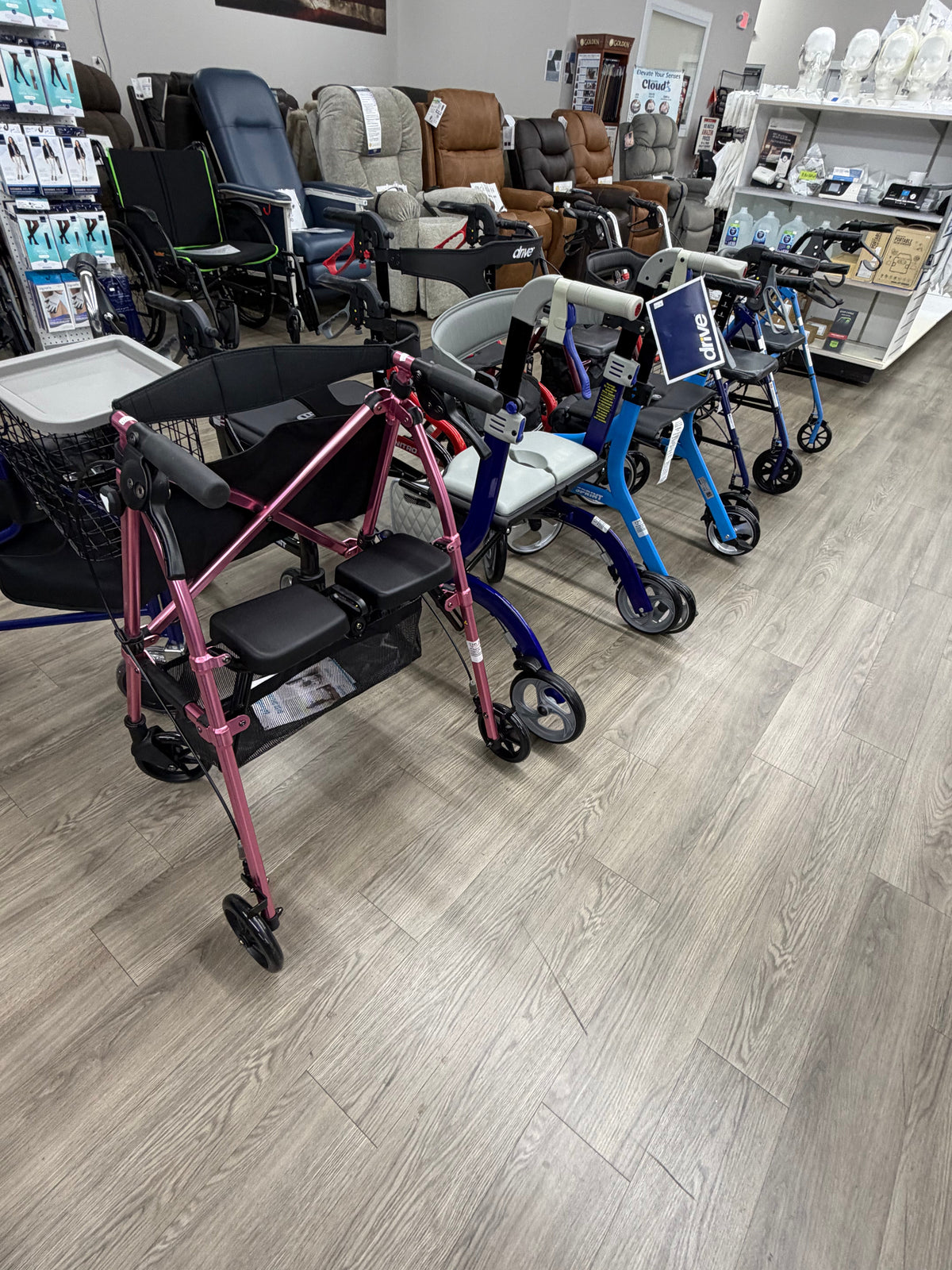
Drive & Medline Rollators: The Complete 2026 Buying, Safety, Brake Maintenance & Repair Guide
Independence Matters. So Does Having the Right Rollator.
For someone experiencing difficulty walking, even ordinary activities can become challenging.
A trip to the grocery store, a doctor's appointment, a walk through the neighborhood, or moving between rooms at home may require more planning and physical effort.
Many people want to remain active but need additional support to do so comfortably.
That's where a properly selected rollator walker can make a meaningful difference.
A rollator is a wheeled walking aid designed to provide support while allowing the user to walk without repeatedly lifting the device. Depending on the model, it may include a seat, backrest, storage bag, adjustable handles, and hand-operated brakes.
Two important names in this market are Drive Medical and Medline.
Both manufacturers offer rollators designed for different mobility needs, physical abilities, body sizes, and everyday environments.
At USA Medical Supply in West Springfield, Massachusetts, we understand that choosing a rollator is not simply about selecting one from a picture.
You need the right size, the right design, properly functioning brakes, and a supplier who can help if the equipment eventually requires maintenance.
As an authorized dealer of Drive and Medline rollators, USA Medical Supply helps customers select suitable equipment and provides rollator service when maintenance or repair is needed.
Because purchasing a rollator is important. Keeping it safe and functional is just as important.
1. What Is a Rollator Walker?
A rollator is a mobility aid equipped with wheels, handles, and a braking system.
Most common models have either three or four wheels.
Four-wheel models frequently include a padded seat and backrest, allowing the user to rest when appropriate.
Unlike a traditional walker, which may need to be lifted and repositioned, a rollator is designed to roll along the walking surface.
This can be helpful for individuals who retain sufficient balance and walking ability but need added support or convenient opportunities to rest.
Common rollator features
Depending on the specific model, features may include:
-
Three or four wheels
-
Loop-style hand brakes
-
Parking-brake locks
-
Adjustable handle height
-
Padded seating
-
Back support
-
Under-seat storage
-
Folding frames
-
Larger outdoor wheels
-
Lightweight aluminum or carbon fiber construction
-
Reinforced frames for higher weight capacities
-
Specialized transport-chair conversion features
No single rollator is appropriate for every user.
The correct choice depends on physical abilities, intended use, home environment, and individual fit.
2. Why Are Rollators Important for Mobility and Independence?
Walking is central to daily life.
When walking becomes more difficult, people may begin avoiding activities they previously enjoyed.
A suitable walking aid may help address some of these limitations.
Supporting everyday movement
A rollator provides a movable support structure that the user can hold while walking.
This can help certain individuals manage everyday distances, provided they have the balance, coordination, hand function, and strength needed to use the device safely.
Providing opportunities to rest
Many four-wheel rollators include a seat.
For someone who tires easily while walking, having an appropriate place to stop and rest can make shopping, appointments, or other outings more manageable.
The brakes must be locked before sitting, and seating should only occur on a firm, level surface.
Supporting participation in daily activities
A rollator may make certain activities more accessible, including walking through a store, visiting family, or moving through a community environment.
The goal is not simply to provide equipment.
It is to help the user participate in daily activities as safely and independently as their abilities permit.
Supporting personalized mobility needs
Rollators are available in different configurations because users have different requirements.
Someone who needs a highly portable device may benefit from a lightweight folding model.
Someone needing more seating room may prefer an extra-wide design.
A person with limited endurance may benefit from a rollator with comfortable seating, or a rollator/transport-chair combination when caregiver assistance is available.
3. What Does Research Say About Rollators?
Rollators are widely used, but scientific research shows that selecting and learning to use them properly is important.
A systematic review examined 18 studies of rollator-assisted walking
A 2019 systematic review titled Walking with Rollator: A Systematic Review of Gait Parameters in Older Personsevaluated 18 independent studies.
Researchers examined walking measurements such as speed and other gait characteristics.
The review found that rollator-assisted walking can influence gait performance, but results differ based on whether someone is an experienced rollator user or is using one for the first time.
The authors emphasized that research was limited and that additional standardized studies were needed.
What this means: A rollator should be selected and fitted for the individual, and people using one for the first time may benefit from instruction and practice.
The research does not establish that simply purchasing a rollator automatically prevents falls.
Source: Mundt et al., 2019 — Rollator Gait Systematic Review.
Walking aids may support participation, but results depend on the user
A systematic review titled Walking Aids for Enabling Activity and Participation examined how walking aids, including rollators, influence participation among adults with physical disabilities.
The review included 13 studies across several walking-aid categories.
It illustrates why mobility devices should be evaluated not only by how they affect walking mechanics, but also by whether they help people accomplish meaningful everyday activities.
Source: Walking Aids for Enabling Activity and Participation.
Why fall prevention remains important
The Centers for Disease Control and Prevention identifies falls as a major health concern among older adults.
Falls can lead to injuries, reduced confidence, and loss of independence.
A rollator can be part of an individualized mobility strategy, but it is not a substitute for proper assessment, safe footwear, strength and balance interventions, or a safer home environment.
Source: CDC — Older Adult Fall Prevention.
At USA Medical Supply, we encourage customers to select a rollator based on their actual mobility needs—not simply the lowest price or the most attractive design.
4. Understanding the Different Types of Rollators
One of the most important things customers should know is that rollators are not all the same.
Different designs serve different needs.
Type 1: Traditional Four-Wheel Rollators
<text></text>
The traditional four-wheel rollator is one of the most familiar designs.
It generally includes:
-
Four wheels
-
Two adjustable handles
-
Hand-operated brakes
-
A seat and backrest
-
Folding capability
-
A storage pouch or basket
Best suited for: Individuals who can walk with a rolling aid and want support along with an opportunity to rest.
Four-wheel rollators are popular for home use, shopping, medical appointments, and community mobility.
Type 2: Three-Wheel Rollators
Three-wheel rollators typically have one front wheel and two rear wheels.
They often have a narrower design and can be maneuverable in smaller spaces.
Many three-wheel models do not include a seat.
Potential advantages: Compact design, easier storage, and maneuverability in appropriate spaces.
Important considerations: A three-wheel design may not provide the same support characteristics as a four-wheel model. Individual balance, turning stability, and intended terrain matter.
Drive offers three-wheel designs, including models in its Nitro family and traditional three-wheel rollator range.
Availability and suitability should be confirmed before purchase.
Type 3: Lightweight Aluminum Rollators
Aluminum rollators are designed to reduce equipment weight while maintaining the strength specified by the manufacturer.
They may be especially appealing to customers who need help placing a rollator into a vehicle.
However, product weight is only one part of the decision.
Frame dimensions, folding design, seating comfort, and lifting ability also matter.
Type 4: Ultra-Lightweight Carbon Fiber Rollators
Carbon fiber rollators are a premium mobility category.
They use lightweight structural materials to reduce total device weight.
A carbon fiber rollator can be easier for some users or caregivers to lift, although it may cost more than a conventional steel or aluminum model.
Customers should consider both the weight of the rollator and its overall dimensions.
A lightweight device that does not fit the user properly is not necessarily the best option.
Type 5: Heavy-Duty and Bariatric Rollators
Some users require a wider seating area, stronger frame, or higher manufacturer-rated weight capacity.
Heavy-duty and bariatric rollators are designed for these needs.
They may feature:
-
Reinforced frames
-
Wider seats
-
Greater space between handles
-
Larger wheels
-
Higher weight capacities
It is important to check the actual maximum load rating of the specific model.
A rollator's weight capacity can include the weight of the user and other loads, subject to the manufacturer instructions.
Type 6: Rollator and Transport-Chair Combinations
A rollator/transport-chair combination is designed to function in two different ways.
First, it can be used as a walking aid.
Second, when properly converted according to the manufacturer's instructions, it can allow a caregiver to push the seated user.
These devices are especially useful to consider when a person can walk some distances but may occasionally require caregiver-assisted transportation.
Important: An ordinary rollator seat does not make a rollator a wheelchair.
Never push someone while seated on a standard rollator that is not specifically designed and configured for transport-chair use.
Type 7: Upright or Forearm-Support Rollators
Upright rollators and forearm-support walkers are designed for people who may benefit from a different upper-body support position.
Some designs include padded forearm supports.
They can be appropriate for selected patients, but they are not automatically better for posture, balance, or stability.
An assessment by a qualified clinician can help determine whether this type of device suits the user's needs.
Type 8: Folding and Travel Rollators
Some rollators fold front-to-back, while others fold side-to-side.
Compact designs can be helpful for:
-
Vehicle transportation
-
Apartment living
-
Storage in limited space
-
Travel
-
Everyday outings
Consider both the folded dimensions and the force required to fold or lift the rollator.
Type 9: Large-Wheel and Outdoor-Oriented Rollators
Some rollators have larger wheels or specialized tires intended to improve maneuverability on certain outdoor surfaces.
Larger wheels may make some surface transitions easier to manage.
However, no standard rollator should be assumed safe on every uneven surface.
Users must follow the manufacturer's restrictions regarding curbs, stairs, slopes, gravel, and other terrain.
5. Medline Rollators: Practical Options for Everyday Mobility
Medline is a well-established medical equipment manufacturer offering products for a range of mobility needs.
USA Medical Supply carries Medline rollator options and helps customers choose among the available designs.
Medline Basic Steel Rollator with 6-Inch Wheels
For customers seeking a traditional rollator, the Medline Basic Steel Rollator is a straightforward option.
Features listed for this model include:
-
Four-wheel design
-
Six-inch wheels
-
Padded seat and backrest
-
Loop-style locking brakes
-
Adjustable handle height
-
Folding frame
The model listed on USA Medical Supply's website has a 250-pound weight capacity, an approximate weight of 14 pounds, and an adjustable handle height of 31–35 inches.
It provides conventional rollator features without requiring a premium design.
Explore the Medline Basic Steel Rollator at USA Medical Supply.
Medline Empower Rollator
The Medline Empower is designed for customers seeking upgraded comfort and convenience.
Its features include:
-
Eight-inch wheels
-
Extra-wide memory foam seat
-
Adjustable handles
-
Loop-style locking brakes
-
Padded backrest
-
Folding frame
-
Storage options
-
Flip-up seat for additional step-in space
According to USA Medical Supply's product listing, the model supports up to 300 pounds.
The Empower's seating arrangement and comfort features may appeal to customers who frequently stop to rest during daily activities.
Explore the Medline Empower Rollator.
Medline Heavy-Duty Rollators
Medline also manufactures heavy-duty rolling walkers.
For example, its MDS86800XWS bariatric model has a manufacturer-specified weight capacity of 500 pounds.
Its official user manual emphasizes safe weight limits, proper height adjustment, brake testing, and the importance of locking the brakes before sitting.
The availability of any particular heavy-duty Medline model should be confirmed with USA Medical Supply.
6. Drive Medical Rollators: From Lightweight Everyday Models to Heavy-Duty Options
Drive Medical offers a broad selection of rollators designed for different levels of mobility, portability, and comfort.
At USA Medical Supply, customers can explore various Drive configurations.
Drive AeroWalk Ultra-Lite Rollator
The Drive AeroWalk Ultra-Lite is designed for customers seeking a lightweight aluminum rollator.
Key features listed for this model include:
-
Approximate product weight of 14.5 pounds
-
Manufacturer-rated 330-pound capacity
-
Ten-inch front wheels
-
Eight-inch rear wheels
-
Adjustable handles
-
Comfortable seat and backrest
-
Side-folding construction
-
Removable storage bag
This design is worth considering when a customer needs a rollator that is relatively easy to transport without sacrificing seating convenience.
Explore the Drive AeroWalk Ultra-Lite Rollator.
Drive AeroCarbon Ultra-Lite Rollator
The Drive AeroCarbon uses carbon fiber construction to achieve a particularly lightweight design.
USA Medical Supply's listed model weighs approximately 11.5 pounds and has a 330-pound weight capacity.
Additional features include:
-
Lightweight carbon fiber frame
-
Folding construction
-
Built-in seat
-
Adjustable backrest
-
Height-adjustable handles
-
Large front wheels
-
Enclosed brake cables
-
Storage bag
This may be a suitable premium option for someone prioritizing low equipment weight.
Explore the Drive AeroCarbon Rollator.
Drive Nitro Sprint HD Rollator
Some customers need a more substantial walking aid.
The Drive Nitro Sprint HD is a heavy-duty model with a manufacturer-rated 500-pound weight capacity.
USA Medical Supply's product listing describes:
-
Reinforced aluminum frame
-
Wider seating area
-
Ten-inch front wheels
-
Contoured back support
-
Side-folding construction
-
Integrated slow-down brake controls
-
Standard hand-brake functions
This model illustrates the importance of comparing weight capacity, seat width, and braking features before selecting a rollator.
Explore the Drive Nitro Sprint HD Rollator.
MD by Drive Excursion XWD Rollator
The Excursion XWD is an extra-wide design featuring:
-
Approximately 400-pound weight capacity
-
Wider seat
-
Padded backrest
-
Eight-inch treaded wheels
-
Ergonomic handgrips
-
Side-folding frame
-
Covered storage basket
It may appeal to users who need additional seating room but still want a rollator that can be folded for storage.
Explore the MD by Drive Excursion XWD.
Drive Duet Rollator/Transport Chair
The Drive Duet combines rollator mobility with caregiver-assisted transport-chair functionality.
It includes a reversible backrest and a transport configuration with appropriate armrests and foot support.
For people whose endurance varies throughout the day, this combination can be particularly useful when a caregiver is available to assist.
All conversion and transport instructions must be followed exactly.
Drive Three-Wheel and Upright Options
Drive's broader rollator catalog also includes compact three-wheel designs and upright walking aids.
Customers interested in these configurations should contact USA Medical Supply to discuss availability, fit, and whether the device is appropriate for their needs.
7. Comparing Drive and Medline Rollators
Both brands offer useful mobility products. Rather than assuming one brand is better for everyone, compare the specific models.
| Feature | Drive Medical | Medline |
|---|---|---|
| Traditional four-wheel rollators | Available | Available |
| Lightweight designs | Available | Available |
| Premium comfort models | Available | Available |
| Heavy-duty options | Available | Available |
| Compact/folding designs | Available | Available |
| Specialized transport combinations | Selected models | Model-dependent |
| Replacement parts | Model-dependent | Model-dependent |
| Brake maintenance | Required as needed | Required as needed |
Examples of models sold through USA Medical Supply
| Model | Listed capacity | Notable feature |
|---|---|---|
| Medline Basic Steel | 250 lbs. | Traditional economical design |
| Medline Empower | 300 lbs. | Memory foam seat |
| Drive AeroWalk | 330 lbs. | Lightweight aluminum |
| Drive AeroCarbon | 330 lbs. | Carbon fiber frame |
| MD by Drive Excursion XWD | 400 lbs. | Extra-wide design |
| Drive Nitro Sprint HD | 500 lbs. | Heavy-duty design |
Specifications apply to the referenced product listings and may vary by model or version. Confirm current specifications, sizing, and availability before ordering.
8. How to Choose the Correct Rollator Height
Proper rollator height is essential.
Handles that are too low may encourage uncomfortable leaning.
Handles that are too high may be difficult to control.
An appropriately sized rollator should generally allow the user to walk with a comfortable, relatively upright position and a slight bend in the elbows.
Medline's rollator guidance describes a fitting method:
-
Stand upright wearing normal walking shoes.
-
Relax the shoulders.
-
Allow the arms to rest naturally at the sides.
-
Position the handles approximately at wrist height.
-
Check that the elbows maintain a comfortable slight bend while holding the grips.
Medline describes an approximate elbow bend of 20–30 degrees in its bariatric rollator instructions.
However, individual mobility limitations, arm length, posture, and strength can change the ideal fit.
Consult a physical therapist or another qualified healthcare professional when needed.
Why seat height also matters
A rollator should not be selected on handle height alone.
The seat should be appropriate for the user's leg length and allow controlled sitting and standing.
A seat that is too high or too low can make transfers uncomfortable or unsafe.
At USA Medical Supply, customers can discuss both handle height and seat dimensions when comparing models.
9. Why Rollator Brakes Are So Important
One of the most important safety features on a rollator is its braking system.
Most traditional rollators have two basic braking functions.
Hand brakes for controlling movement
Squeezing the brake levers engages the brakes to help slow or stop the rollator.
These brakes must function consistently and respond to appropriate hand pressure.
Parking brakes for a stationary position
Many models allow the user to press the brake levers downward until they lock.
This function helps hold the rollator stationary when the user needs to rest on the seat.
Before sitting on a rollator, the parking brakes must be locked and verified to be functioning.
Do not sit on a rollator on a slope or uneven surface.
Why both brakes should work properly
If one brake works differently from the other, the rollator may not respond as expected.
If the parking brakes do not lock, sitting can become hazardous.
If a brake cable becomes damaged or stretched, braking performance may deteriorate.
These are not problems that should be ignored.
10. Rollator Brakes Will Eventually Need Attention: Why Professional Maintenance Matters
A rollator contains moving mechanical components.
Like other equipment that experiences regular use, its brakes and wheels can require adjustment, maintenance, or replacement.
Potential issues include:
-
Brake cable stretch or damage
-
Loose adjustment hardware
-
Worn brake contact surfaces
-
Broken brake levers
-
Parking brakes that fail to lock
-
Brake mechanisms that drag
-
Wheels that wobble
-
Cracked or worn tires
-
Loose fasteners
-
Damaged grips or folding components
Not every rollator will need brake repair at the same time.
Frequency depends on use, terrain, device design, exposure to moisture, and component wear.
But every rollator needs periodic inspection, and problems should be addressed promptly.
What Medline says about brake inspections
Medline's official bariatric rollator manual instructs users to check the brakes before each use.
It also states that the rollator's moving parts must be secure and functioning properly.
The manufacturer warns that brake adjustments must be tested before the device is used again.
Medline publishes model-specific instructions explaining brake cable adjustments and the importance of retesting the locking mechanism.
This demonstrates that brake inspection and adjustment are recognized elements of rollator maintenance.
Source: Medline Bariatric Rollator User Manual.
What Drive says about brake maintenance
Drive Medical also publishes technical guidance for rollator brake systems.
Its Nitro service documentation includes procedures for replacing brake cables and associated components.
That is an important reminder that a rollator's braking system includes serviceable mechanical parts, depending on the model and parts availability.
Source: Drive Medical Nitro Brake Service Instructions.
Why professional service can be valuable
Some rollator manufacturers provide user-level adjustment instructions.
However, not everyone is comfortable evaluating cable tension, brake engagement, worn parts, or mechanical damage.
An incorrectly adjusted brake can create a serious safety risk.
When in doubt, having the equipment inspected by a knowledgeable medical equipment service provider is the safer choice.
This is one of the reasons we encourage customers to purchase from an authorized local dealer that also offers service.
11. USA Medical Supply: We Don't Just Sell Rollators. We Service Them.
Buying a rollator online from an unfamiliar seller may appear convenient.
But what happens six months or two years later when something needs attention?
What happens when the brake no longer locks?
What if a wheel begins wobbling, a component becomes loose, or a brake cable needs replacement?
These are practical questions worth considering before purchase.
At USA Medical Supply, we believe customers deserve ongoing support.
As an authorized dealer of Drive and Medline rollators, we sell quality mobility equipment and offer service when a rollator needs maintenance or repair.
Rollator service may include
Depending on the model, condition, and replacement-part availability, service may involve:
-
Brake inspections
-
Brake adjustments
-
Brake cable replacement
-
Brake lever evaluation
-
Wheel and tire inspections
-
Replacement of compatible worn parts
-
Evaluation of loose hardware
-
Folding mechanism checks
-
General mechanical safety inspections
Some repairs may require ordering manufacturer-compatible parts. Other problems may make replacement of the device more appropriate than repair.
Our team can help evaluate the available options.
Why buying from a local dealer matters
When you purchase a rollator from USA Medical Supply, you have a local business to contact when questions arise.
Our West Springfield location serves customers throughout Western Massachusetts and nearby communities in Connecticut.
Whether you are purchasing your first rollator, comparing upgraded models, or experiencing a brake problem with an existing device, our team can help guide you toward the appropriate next step.
Your rollator supports your mobility. Our goal is to help you keep it operating as intended.
12. Warning Signs Your Rollator Needs Professional Service
Do not wait for a complete mechanical failure.
Warning sign 1: The parking brake won't stay locked
This deserves immediate attention.
If the brake does not reliably engage and hold as specified by the manufacturer, the rollator should not be used until evaluated.
Warning sign 2: One brake feels different from the other
A difference in tension or braking response can indicate uneven adjustment or mechanical wear.
Warning sign 3: The rollator pulls to one side
Uneven rolling or braking behavior may suggest a problem involving wheels, alignment, or brake mechanisms.
Warning sign 4: The wheels wobble
Wobbling wheels can indicate loose or damaged components.
Warning sign 5: The brakes drag even when released
Dragging can make walking harder and may indicate an adjustment or component problem.
Warning sign 6: The frame or folding mechanism feels loose
A rollator should feel secure when fully opened and correctly locked.
Unexpected frame movement should be evaluated before further use.
Warning sign 7: The handgrips move unexpectedly
Loose grips can compromise control.
Warning sign 8: You hear new clicking or grinding noises
Unusual sounds can signal mechanical wear or damage.
If any of these problems appear, avoid using the rollator until it has been assessed and returned to safe working condition.
Contact USA Medical Supply about an appropriate inspection or service appointment.
13. How Often Should Rollator Brakes Be Checked?
There is no single universal maintenance interval covering every rollator model.
Follow the specific manufacturer's instructions.
A useful general routine is:
| Frequency | Recommended action |
|---|---|
| Before every use | Check brakes, wheels, frame, handles and locking mechanisms |
| Regularly | Inspect tires, cables, grips and folding components for wear |
| After a fall, collision or unusual impact | Have the affected device inspected before reuse |
| Whenever braking becomes inconsistent | Stop use and obtain service |
| When components are damaged | Repair or replace using suitable manufacturer-compatible parts |
This is a practical inspection schedule rather than a promise that routine maintenance can eliminate all mechanical failures.
Do not assume a rollator is safe simply because it appears clean or was purchased recently.
14. Can Rollator Brakes Be Adjusted?
Many rollator models have adjustable brake systems.
However, the procedure varies.
Some have exposed brake cables and adjustment nuts.
Others incorporate concealed cable designs or specialized braking mechanisms.
An adjustment appropriate for one model may be wrong for another.
It is essential to follow the manual for the exact device.
Never operate a rollator with brakes that fail the manufacturer's functional check.
Customers who need help with their Drive or Medline rollator can contact USA Medical Supply for service guidance.
15. Can Rollator Wheels and Brakes Be Replaced?
Depending on the device, compatible replacement parts may be available.
These can include:
-
Brake cables
-
Brake levers
-
Wheels
-
Handle grips
-
Seat or backrest components
-
Folding hardware
-
Other manufacturer-approved parts
Parts are model-specific and availability varies.
Some repairs are relatively straightforward; others may not be economical or advisable.
Damage to a load-bearing frame, severe corrosion, or extensive structural deterioration may mean replacing the rollator is safer than attempting a repair.
Never weld, glue, or improvise repairs on load-bearing components without manufacturer authorization.
16. How to Use Your Rollator Safely
Proper equipment selection is only one part of safe mobility.
The way a rollator is used is equally important.
Keep the device close while walking
Use the rollator according to your therapist's and manufacturer's instructions.
Avoid walking so far behind the handles that you must excessively reach forward.
Keep both hands in the appropriate position
Most conventional rollators are designed for two-handed operation.
People with limited hand strength or restricted use of one arm may need a different device or specialized braking system.
Use the brakes correctly
Learn how to slow, stop, engage the parking brakes, and confirm that the parking brakes are holding.
Lock the brakes before sitting
Position the rollator on a firm, level surface.
Engage both parking brakes.
Verify stability before sitting.
Do not pull yourself up using an unstable rollator
Medline specifically warns against pulling on a rollator to stand from a lower position because the device can move even when its brakes are locked.
Follow a clinician's guidance on safe transfers.
Never use a standard rollator as a wheelchair
A seated person should never be pushed on an ordinary rollator.
Only a model expressly designed as a transport-chair combination may be used in that configuration, following its specific instructions.
Be especially careful around slopes and obstacles
Use the device only on surfaces permitted in the manufacturer's instructions.
Certain rollator manuals specifically prohibit use on stairs, curbs, slopes, or uneven ground.
Never assume large wheels eliminate these restrictions.
Avoid carrying excessive weight
Use storage baskets and bags only within their rated limits.
Avoid hanging heavy objects from handles, which may compromise balance.
Learn to fold and unfold it correctly
Always verify that the frame is fully opened and locked before walking.
17. Should You Choose a Rollator or a Traditional Walker?
Although they are frequently grouped together, standard walkers and rollators are designed for different mobility needs.
| Feature | Traditional walker | Rollator |
|---|---|---|
| Wheels | None or limited wheels | Usually 3 or 4 |
| Typical braking system | Generally not applicable | Hand brakes |
| Seat | Usually no | Common on four-wheel models |
| Movement | Often lifted or advanced | Rolls while walking |
| Primary advantage | May provide more controlled support for selected users | Continuous rolling mobility for suitable users |
| Important consideration | Requires ability to advance walker safely | Requires sufficient balance and brake control |
A traditional walker may be preferable when a person needs a more stable support structure or cannot safely control a rollator.
A rollator may be appropriate when the person can control a rolling device and benefits from its maneuverability.
A physical or occupational therapist can help determine which walking aid is appropriate.
18. Is a Rollator Covered by Medicare?
Medicare Part B may cover a qualifying walker when the applicable medical-necessity and coverage requirements are satisfied.
According to Medicare's walker coverage policy, the patient generally must have a mobility limitation that significantly affects mobility-related activities of daily living in the home, be able to use the walker safely, and have a mobility need that the walker can sufficiently address.
Additional criteria apply to certain heavy-duty and specialized devices.
Coverage is not automatic simply because someone is older or has difficulty walking.
The prescription, clinical documentation, device classification, supplier status, and insurance requirements all matter.
Premium features and specific retail models may not be fully covered, even when a basic walker is eligible.
Contact your insurer and supplier to verify eligibility, costs, and available options before purchasing.
Source: Medicare Walkers Local Coverage Determination.
19. Why Choosing an Authorized Drive and Medline Dealer Matters
The price of a rollator is important, but it should not be the only consideration.
A qualified dealer can help customers compare:
-
Overall width
-
Handle height
-
Seat height
-
Weight capacity
-
Frame weight
-
Folding design
-
Wheel size
-
Brake design
-
Replacement-part considerations
-
Service and repair options
An authorized dealer is also a useful point of contact for product support and questions about manufacturer warranties.
Warranty coverage varies by manufacturer and model, and ordinary wear or maintenance may not be covered.
At USA Medical Supply, we encourage customers to think beyond the first day of ownership.
A rollator may be used regularly for years.
Knowing where to turn when maintenance is required offers practical long-term value.
20. Frequently Asked Questions About Drive and Medline Rollators
What is the difference between a walker and a rollator?
A traditional walker generally provides a support frame that must be lifted or advanced in a controlled manner. A rollator has wheels and hand brakes, allowing it to roll while walking.
Which is better, Drive or Medline?
Both offer rollators for a variety of mobility needs. The best choice depends on fit, stability, weight capacity, braking ability, comfort, and intended use.
Are three-wheel rollators better than four-wheel rollators?
Not necessarily. Three-wheel models may be more compact, while four-wheel models commonly include a seat and may offer a different support configuration. The user should be assessed individually.
Do all rollators have seats?
No. Many four-wheel models have seats, but some three-wheel and specialty models do not.
What is a bariatric rollator?
A bariatric rollator is a heavy-duty device with a higher manufacturer-rated weight capacity, often accompanied by wider frame or seating dimensions.
Can a rollator help prevent falls?
An appropriately selected rollator may help certain users manage mobility, but it does not guarantee fall prevention. Correct fit, training, balance, and safe equipment condition are important.
Should a rollator be fitted to my height?
Yes. Proper handle and seat height matter for comfort and safe use.
What if my rollator brakes stop working?
Stop using the rollator and arrange an inspection or repair. Do not continue using a device with unreliable brakes.
Do rollator brakes need regular adjustment?
They may. Cables and other mechanical components can require adjustment or replacement depending on use and wear.
Can USA Medical Supply repair Drive rollators?
USA Medical Supply provides rollator service. Contact the store with the model and description of the problem so the team can assess available repair options and parts.
Can USA Medical Supply service Medline rollators?
Yes. Contact USA Medical Supply to discuss your Medline model and service needs. The available work depends on the model, condition, and compatible replacement parts.
How do I know whether my rollator should be repaired or replaced?
That depends on the condition of the frame, brakes, wheels, parts availability, and the cost and safety of repair.
Can I use my rollator as a wheelchair?
No, unless it is specifically designed for transport-chair use and is correctly configured according to its manual.
Are larger wheels always better?
No. Wheel size should be considered alongside width, maneuverability, terrain, stability, and user ability.
Can I bring my rollator to USA Medical Supply for service?
Contact the West Springfield store to discuss the problem and arrange the appropriate next steps. This allows the team to determine whether an inspection, adjustment, parts order, or repair is needed.
Can I purchase a rollator directly from USA Medical Supply?
Yes. USA Medical Supply offers rollators and other mobility equipment through its retail business and website.
21. Serving Western Massachusetts and Northern Connecticut
USA Medical Supply is located at:
1779 Riverdale Street, West Springfield, MA 01089
Our location is convenient for customers throughout the Greater Springfield region and surrounding Western Massachusetts and Northern Connecticut communities.
Whether you are purchasing a rollator for yourself or helping a family member select mobility equipment, our team can assist with product selection and service questions.
We understand that mobility equipment can be an essential part of daily independence.
That's why dependable equipment and ongoing support both matter.
USA Medical Supply — Authorized Drive and Medline Rollator Dealer
-
Phone: 413-733-7843
-
Text: 413-200-4191
-
Website: www.USAMedicalSupply.com
-
Shop rollators: Browse Drive, Medline and Other Rollators
Final Thoughts: Buying the Right Rollator Is Only the Beginning
A good rollator can help make everyday mobility more manageable.
It can provide support while walking, offer a place to rest, and make certain outings more accessible.
But rollators are mechanical mobility devices.
Wheels wear. Components loosen. Brake cables may need adjustment or replacement. Folding mechanisms need to remain secure.
The brakes that work perfectly when a rollator is new may require attention after extended use.
That's why it makes sense to consider service and maintenance before choosing where to purchase.
At USA Medical Supply, we believe that selling you the rollator is only part of our responsibility. Helping you keep it in dependable working condition matters, too.
As an authorized dealer for Drive and Medline rollators, we offer customers access to quality mobility equipment, knowledgeable assistance, and ongoing rollator service.
Whether you need your first rollator, want to upgrade to a premium lightweight model, or need help with brakes that are no longer functioning correctly, contact our team.
Visit USA Medical Supply in West Springfield, Massachusetts, or explore our rollators online at USAMedicalSupply.com.
Safety note: Walking aids must be appropriate for the user's needs and used according to the specific manufacturer instructions. This article provides general consumer education and does not replace a clinical mobility evaluation or the device's user manual. Service and repair availability depends on the product, its condition, and compatible parts.
Complete Bibliography and References
Manufacturer documentation
-
Drive Medical. Rollators: Good, Better, Best Options. Manufacturer comparison chart. Drive Medical Rollator Comparison Guide.
-
Drive Medical. Nitro Rollator Brake Service Instructions. Manufacturer brake service documentation.
-
Medline Industries. MDS86800XWS Bariatric Rollator: User Instructions and Warranty. Official Medline Manual.
-
Medline Industries. MDS86825SLRS Rollator User Instructions. Includes brake adjustments and maintenance information. Official Medline Manual.
Scientific research
-
Mundt, M., Batista, J. P., Markert, B., Bollheimer, C., & Laurentius, T. (2019). Walking with Rollator: A Systematic Review of Gait Parameters in Older Persons. European Review of Aging and Physical Activity, 16, Article 15. https://doi.org/10.1186/s11556-019-0222-5.
-
Walking Aids for Enabling Activity and Participation: A Systematic Review. American Journal of Physical Medicine & Rehabilitation. PubMed PMID 29176406.
-
Rollator Use Adversely Impacts on Assessment of Gait and Mobility During Geriatric Rehabilitation. PubMed PMID 21448557.
Government guidance
-
Centers for Disease Control and Prevention. About Older Adult Fall Prevention. CDC Fall Prevention Resources.
-
Centers for Medicare & Medicaid Services. Local Coverage Determination: Walkers (L33791). CMS Coverage Policy.
USA Medical Supply product references
-
USA Medical Supply. Drive and Medline Rollator Collection.
-
USA Medical Supply. Medline Basic Steel Rollator.
-
USA Medical Supply. Medline Empower Rollator.
-
USA Medical Supply. Drive AeroWalk Ultra-Lite Rollator.
-
USA Medical Supply. Drive AeroCarbon Ultra-Lite Rollator.
-
USA Medical Supply. Drive Nitro Sprint HD Rollator.
-
USA Medical Supply. MD by Drive Excursion XWD Rollator.