
Golden Technologies Lift Chairs, Scooters & Power Wheelchairs: Complete 2026 FAQ Guide
USA MEDICAL SUPPLY • CORNERSTONE BUYER'S GUIDE • OCTOBER 10, 2026
Golden Technologies Lift Chairs, Mobility Scooters & Power Wheelchairs: The Ultimate 2026 Buying Guide and Frequently Asked Questions


Golden Technologies Lift Chairs, Scooters & Power Wheelchairs: Complete 2026 FAQ Guide
Introduction: Finding the Right Golden Technologies Product for Your Independence and Comfort
Choosing a lift chair, mobility scooter, or power wheelchair is about much more than choosing a style or comparing prices. The right equipment should fit your body, match your physical abilities, accommodate your home, and support the activities that matter most to you.
For someone who struggles to stand from a recliner, a power lift chair can provide meaningful assistance. For someone who can walk short distances but has difficulty navigating stores, shopping centers, or longer outings, a mobility scooter may be useful. For a person who needs powered mobility throughout the home and has difficulty safely using a scooter's steering controls, a power wheelchair may be more appropriate.
Golden Technologies is known for its power lift recliners, patented positioning technologies, mobility scooters, and power wheelchairs.
Golden's current product offerings include multiple chair comfort-zone configurations, compact travel equipment, full-size outdoor scooters, heavy-duty mobility options, and folding power wheelchairs.
At USA Medical Supply, our goal is to help individuals and families understand their options before making an important purchase.
This guide covers three major categories:
-
Golden power lift recliners: How they work, who benefits, positioning technologies, model comparisons, fit, safety, and care.
-
Golden mobility scooters: Three-wheel versus four-wheel designs, portability, battery range, terrain, transportation, and selecting the right scooter.
-
Golden power wheelchairs: Joystick operation, folding chairs, center-wheel drive, seating needs, maneuverability, and long-term ownership.
It also explains Medicare considerations, insurance limitations, warranties, servicing, travel, and questions to ask before buying.
Part One: Golden Technologies Power Lift Recliners


Understanding the Golden lift chair collections
Golden categorizes its power lift recliners by positioning capabilities, comfort features, and sizing needs.
|
Collection or technology |
Primary benefit |
|---|---|
|
Traditional one-zone lift recliners |
Simpler sit, lift, and recline operation |
|
MaxiComfort positioning |
Expanded powered recline and zero-gravity-style positioning |
|
Twilight Tilt |
Additional tilt-in-space positioning |
|
Small to Tall |
Different dimensions for petite, average, tall, and wider users |
|
Heavy Duty |
Reinforced configurations for higher weight capacities |
Golden advertises heavy-duty configurations supporting up to 600 pounds, depending on the specific model and size.
Golden lift chair model guide
The following are identifiable Golden recliner models and families in the manufacturer's catalog reviewed for this guide. Models, dimensions, fabrics, and availability can change.
|
Model |
Design and primary distinction |
|---|---|
|
Comforter PR531 |
Traditional one-zone positioning; extensive size choices |
|
Comforter MaxiComfort PR535 |
Two-zone positioning with petite-to-tall options |
|
Cambridge PR401 |
Traditional one-zone recliner available in small, medium, and large |
|
Cloud Classic PR510 |
Plush bucket-style comfort with MaxiComfort positioning |
|
Cloud+ PR511 |
Four-zone positioning; optional premium wellness features |
|
Cloud+ Luxe PR525 |
Five-zone design with Twilight Tilt |
|
Cloud Elite PR527 |
Five-zone Twilight model with overstuffed styling |
|
Cloud Supreme PR519 |
Five-zone premium Twilight recliner |
|
Cloud PR517-MLA |
Four-zone medium/large Cloud variant |
|
Relaxer PR766 |
Two-zone MaxiComfort model with waterfall-back pillows |
|
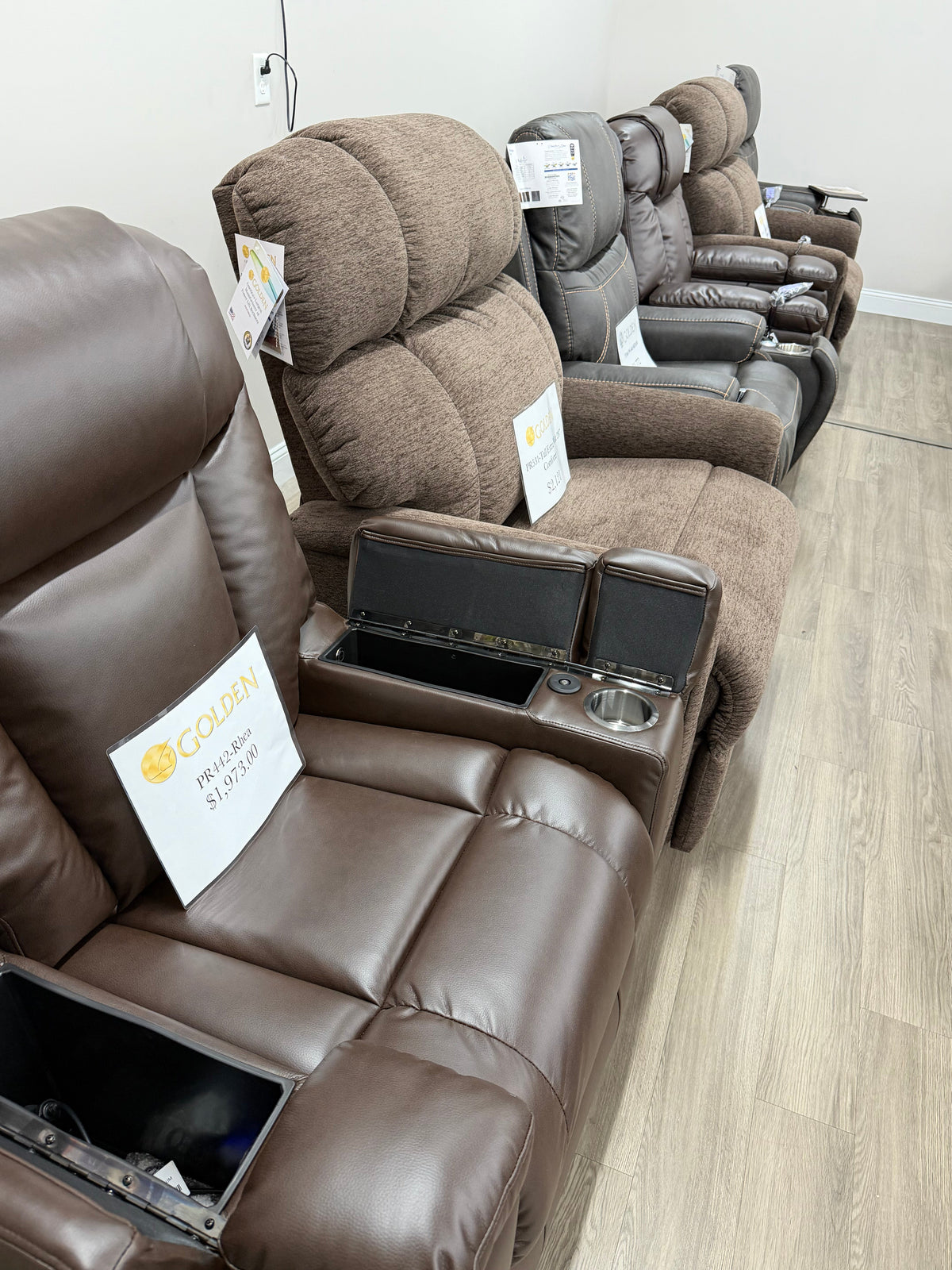
Rhea PR442 |
Four-zone recliner with open-arm design |
|
Rhea PR447 |
Five-zone Twilight and Nirvana wellness configuration |
|
Titan PR448 |
Four-zone MaxiComfort recliner |
|
Titan PR449 |
Five-zone Twilight model |
|
Dione PR446 |
Four-zone MaxiComfort positioning |
|
EZ Sleeper PR750 |
Four-zone slim-design model |
|
EZ Sleeper PR764 |
Five-zone slim-design Twilight model |
|
EZ Sleeper PR761 |
Five-zone Twilight recliner |
Golden also publishes additional models and size variations, including the Elara in its DeLuna family. Consult the current manufacturer listing before selecting an exact configuration.
Lift Chair FAQs: Fundamentals
1. What is a Golden Technologies power lift chair?
A Golden power lift chair is an electrically operated recliner with a powered lifting mechanism that raises the seating surface and helps the user transition toward standing.
Unlike an ordinary power recliner, a lift chair assists with both reclining and standing.
The chair uses powered mechanical components controlled through a hand control. The amount of independent positioning depends on the model.
2. Who should consider buying a lift chair?
People who experience difficulty transitioning from sitting to standing may benefit from a properly fitted lift chair, particularly those with reduced leg strength or mobility limitations.
Examples include people with arthritis, joint stiffness, reduced endurance, or certain physical disabilities.
However, a lift chair is not suitable for every transfer difficulty. A physical or occupational therapist can help determine whether the person can safely stand from the raised position.
3. What is the difference between a lift chair and a regular recliner?
A traditional recliner allows its occupant to lean back and elevate their legs.
A lift chair performs these functions but also uses a powered mechanism to elevate and tilt the chair forward.
The lifting feature can reduce the effort required to initiate standing, although the user must still have sufficient balance and functional ability to complete the transfer safely.
4. Do all Golden lift chairs recline completely flat?
No. Recline capabilities vary.
Some Golden models offer traditional three-position reclining, while others provide MaxiComfort or Twilight positioning.
A buyer seeking an extended recline or near-flat position should verify the precise model's specifications and try the position before purchasing.
5. Can a lift chair replace a bed?
Not automatically.
Even if a chair reclines into a comfortable position, it does not necessarily provide the pressure management, positioning, transfer accessibility, or sleep support of an appropriate bed.
For people who sleep in a chair because of breathing difficulties, pain, swelling, or trouble lying flat, medical evaluation is advisable.
6. Are Golden lift chairs considered medical devices?
Golden identifies its lift recliners as FDA Class II medical devices intended to assist people with physical disabilities. This classification does not mean every model or wellness feature has been demonstrated to treat an individual medical condition.
7. Are Golden lift chairs made in America?
Golden manufactures lift recliners in Old Forge, Pennsylvania, and describes its American manufacturing and inspection processes on its website.
Buyers should confirm the origin of the specific model rather than assume every component or product Golden sells is domestically made.
8. How long does a Golden lift chair last?
There is no guaranteed service life. Longevity depends on usage, weight loading, mechanical wear, cleaning, environment, and maintenance.
A chair operated repeatedly throughout the day may experience different wear from one used occasionally.
Warranty duration should not be confused with guaranteed product lifespan.
Lift Chair FAQs: Comfort and Positioning
9. What are Golden Comfort Zones?
Golden uses Comfort Zones to describe independently controlled regions of chair positioning.
These can include the headrest, lumbar region, back, seat, and footrest, depending on the model.
A chair with more Comfort Zones generally allows more personalized adjustments than a basic one-zone model.
10. What is Golden MaxiComfort positioning?
MaxiComfort is Golden's patented positioning system that provides extended powered seating adjustments, including its zero-gravity-style positioning.
It is designed to support a range of recline positions through the movement of the chair's seating mechanism.
It may help users find comfortable positions, but it should not be represented as treatment for circulation disorders, pressure injuries, or spinal disease.
11. What is Golden Twilight Tilt technology?
Twilight Tilt is Golden's patented tilt-in-space positioning system.
Rather than simply reclining the backrest, it allows the seated body to tilt backward in a coordinated motion.
The system is offered on selected five-zone models and expands the range of available positioning choices.
12. What is the difference between MaxiComfort and Twilight Tilt?
MaxiComfort focuses on expanded reclining and lower-body positioning.
Twilight Tilt adds a coordinated backward tilt of the seating structure.
People comparing the two should experience both systems, paying attention to head support, lower-back comfort, leg positioning, and their ability to return safely to an upright position.
13. What is zero-gravity positioning in a lift chair?
Zero-gravity is a term used to describe a reclined posture that redistributes body weight and changes the relationship between the torso and legs.
It does not mean gravity is eliminated.
Positioning marketed as zero-gravity may feel relaxing, but personal comfort varies, and not every configuration is appropriate for every medical condition.
14. Is zero-gravity positioning good for swollen legs?
Leg elevation may be helpful for some causes of swelling, but the appropriate elevation, duration, and underlying treatment depend on the medical cause.
Persistent swelling should be evaluated by a clinician. Sudden swelling, especially with pain, redness, or shortness of breath, warrants prompt medical attention.
15. Can a Golden lift chair help with back pain?
Proper seating support and adjustable positioning may improve comfort for some individuals.
However, back pain has many causes, and no Golden chair should be assumed to treat the condition.
Seat depth, lumbar support, cushion firmness, and available position changes may be more important than the number of features alone.
16. What is adjustable lumbar support?
Adjustable lumbar support changes the amount of support near the lower back.
It can be useful for finding a comfortable sitting position, especially during extended sitting.
Not every Golden model includes powered lumbar adjustment.
17. What is an adjustable power headrest?
A powered headrest allows the head and neck support to move independently on equipped models.
This can be helpful when watching television, reading, or maintaining a comfortable head position while reclining.
18. What is Golden Nirvana massage?
Golden offers Nirvana wellness features on selected models, including Swedish-style air massage systems and far-infrared heat configurations.
Availability differs between chairs and may be standard or optional.
19. What is Golden HeatWave technology?
HeatWave is Golden's branded far-infrared heat feature offered with certain wellness configurations.
It is intended for comfort and relaxation. Claims about treating disease or producing specific clinical outcomes should not be inferred from the product name.
20. Can massage and heat be used together?
On models equipped with both compatible functions, users may be able to operate them as described in the chair's instructions.
Individuals with reduced heat sensation, neuropathy, impaired circulation, or conditions affecting skin integrity should consult a healthcare professional before using heat features.
21. Are lift chairs appropriate for someone with poor circulation?
A lift chair may assist with comfortable positioning, but it is not a substitute for medical evaluation or treatment.
The best position can differ depending on whether the person has venous disease, arterial disease, heart failure, or another condition.
Lift Chair FAQs: Sizing and Fit
22. How do I determine the correct lift chair size?
Measure the person rather than choosing based only on labels such as small, medium, or large.
Important measurements include seat width, seat depth, floor-to-seat height, back height, and the distance from the seat to the armrests.
A proper fit allows the user to sit with adequate thigh support, a supported back, and feet positioned appropriately when upright.
23. What happens if the seat is too deep?
The person may have difficulty maintaining back support while keeping their feet properly positioned.
They may slide forward, sit with poor posture, or struggle during transfers.
24. What happens if the chair is too high?
A seat that is too high can leave the feet unsupported or make the transition to standing less controlled.
Correct seat height matters even when the chair has a lifting mechanism.
25. What if the chair is too narrow?
An overly narrow seat can create uncomfortable pressure against the thighs and hips, limit repositioning, and make transfers difficult.
The chair should provide appropriate clearance without being so wide that armrest support becomes ineffective.
26. Does Golden manufacture petite lift chairs?
Yes. Golden's Comforter and other size-specific offerings include petite or smaller configurations.
The available sizes depend on the model.
27. Does Golden manufacture lift chairs for tall people?
Yes. Golden's Small to Tall collections include taller configurations.
Tall users should pay particular attention to back height, seat depth, leg support, and footrest extension.
28. Are there Golden lift chairs for larger individuals?
Yes. Selected Comforter and Cloud configurations support higher weight capacities, with some configurations rated up to 600 pounds.
The exact size, weight rating, and availability must be confirmed for the selected model.
29. How much clearance does a lift chair require from the wall?
The required distance differs by model.
For example, Golden's Relaxer PR766 specifies a 21-inch distance from the wall when reclined in the configuration shown on its published specification sheet.
Always follow the clearance specification for the exact chair and consider surrounding furniture and walking pathways.
30. Can a lift chair fit through a narrow doorway?
Possibly, depending on the chair's dimensions and whether the backrest can be separated for delivery.
Measure door openings, hallways, turns, and stair access before ordering. Never assume that the seating width is the same as the overall chair width.
Lift Chair FAQs: Specific Golden Models
31. What makes the Golden Comforter PR531 different?
The Comforter emphasizes size selection and straightforward one-zone operation. It is particularly worth considering when correct dimensions and a simple control experience are the main priorities.
Golden publishes multiple size configurations under the Comforter family.
32. How does the Comforter PR535 compare?
The Comforter PR535 adds MaxiComfort positioning while retaining the size-focused philosophy of the Comforter collection.
It may appeal to buyers who want additional recline versatility without giving up the importance of fit.
33. What is the Golden Cloud Classic PR510?
The Cloud Classic is a plush, bucket-style lift recliner featuring MaxiComfort positioning.
Its design prioritizes enveloping comfort. People who prefer a firmer or flatter seat should compare it with alternative styles.
34. Why consider the Golden Cloud+ PR511?
The Cloud+ offers four-zone positioning and optional premium wellness technologies.
It is an option for buyers who want multiple powered adjustments without necessarily requiring Twilight Tilt.
35. What distinguishes the Cloud+ Luxe PR525?
The Cloud+ Luxe moves to five-zone positioning with Twilight Tilt, offering additional positional flexibility.
It also has optional wellness configurations.
36. What makes the Cloud Supreme PR519 a premium model?
The Cloud Supreme combines plush comfort, five-zone positioning, and Golden's Twilight Tilt and MaxiComfort technologies.
Its appeal is the combination of supportive recliner styling and expanded adjustability.
37. Who should consider the Golden Rhea?
The Rhea family features a distinctive open-arm design, with some configurations offering integrated accessories and advanced wellness features.
The PR442 and PR447 differ in positioning systems and capabilities, so the model number should be checked carefully.
38. What is the Golden Titan?
The Titan is a lift recliner family offering MaxiComfort positioning, with a Twilight-equipped variation.
The PR448 and PR449 should not be assumed to have identical control systems or positioning features.
39. What is special about the Golden EZ Sleeper?
The EZ Sleeper family emphasizes a more tailored appearance with advanced powered positioning on selected models.
The difference between four-zone and five-zone versions is important when comparing configurations.
40. Which Golden lift chair is best?
The most appropriate model depends on the user's dimensions, ability to transfer, desired seating support, medical precautions, budget, and preference for controls and recline positions.
A properly fitted chair with fewer features can be a better purchase than a premium chair that fits poorly.
Lift Chair FAQs: Safety, Electricity, Repairs, and Medicare
41. Can a Golden lift chair help prevent falls?
A properly used lift chair may reduce some of the physical effort required to stand, but it cannot guarantee fall prevention.
A person still needs appropriate strength, balance, footwear, and an unobstructed standing area. A therapist can assess whether the transfer is safe.
42. Can someone with dementia use a power lift chair?
Suitability depends on the person's cognitive abilities, behavior, transfer skills, and supervision.
Someone who cannot reliably understand or operate the controls may need additional assistance. Unsupervised operation may be unsafe.
43. Can you stand on the footrest?
No. Never stand or sit on an extended footrest unless the manufacturer explicitly designed it for that purpose. Doing so can cause injury, instability, or mechanical damage.
44. What happens if the electricity goes out?
Many Golden lift recliners offer emergency battery-backup functionality intended for limited operation during a power interruption.
Backup systems vary. Some use disposable 9-volt batteries, while others may have different provisions.
Do not assume the backup system can operate a chair repeatedly or for an extended outage. Consult the model's owner's manual and maintain an emergency plan.
45. Why is my lift chair not moving?
Potential causes include a disconnected power plug, loose transformer connection, hand-control malfunction, damaged cable, exhausted backup batteries, or an internal mechanical/electrical issue.
Check only the safe troubleshooting steps provided by Golden. Do not place your hands underneath a powered chair or attempt to force its lifting mechanism.
46. Why is my lift chair moving slowly?
Slow movement may be associated with loading, power supply issues, mechanical resistance, or developing component faults.
Stop using the chair if you notice unusual sounds, jerky movement, overheating, or an apparent electrical problem. Arrange an assessment rather than attempting an improvised repair.
47. Are Golden lift chair motors covered by warranty?
Coverage depends on the specific model, component, purchase circumstances, and written warranty.
For example, Golden publishes separate coverage periods for frame components, electrical parts, and labor on certain models. These periods should not be assumed to be identical across the entire range.
48. Where is the lift chair serial number?
Golden identifies the owner's manual, lifting frame, and hand-control wiring as possible serial-number locations.
The serial number is important when requesting technical support or replacement parts.
49. Does Medicare pay for Golden lift chairs?
Original Medicare may cover a medically necessary seat lift mechanism, but it generally does not pay for the entire recliner or its furniture components.
CMS specifies strict requirements, including severe hip or knee arthritis or severe neuromuscular disease, inability to stand from an ordinary chair, and the ability to walk once standing.
A qualifying prescription and appropriate documentation are required.
50. Will Medicare cover a lift chair simply because I am elderly?
No. Age alone does not establish Medicare medical necessity.
A physician's recommendation by itself also does not guarantee coverage. The applicable clinical and documentation requirements must be met.
Part Two: Golden Technologies Mobility Scooters


A mobility scooter can help individuals with limited walking endurance participate in everyday activities, visit family, shop, and travel more comfortably.
However, scooters differ substantially in portability, stability, size, range, and intended environments.
Golden mobility scooter model comparison
The manufacturer's catalog includes the following models and configurations.
|
Scooter |
Model number |
Published capacity |
Primary category |
|---|---|---|---|
|
Buzzaround CarryOn |
GB120 |
300 lb |
Folding travel |
|
Buzzaround CarryOn HD |
GB220 |
400 lb |
Heavy-duty travel |
|
Buzzaround XL 3-Wheel |
GB121-STD |
300 lb |
Compact portable |
|
Buzzaround EX 3-Wheel |
GB118 |
350 lb |
Portable extended-range |
|
Buzzaround EX 4-Wheel |
GB148 |
350 lb |
Portable extended-range |
|
Buzzaround LX 3-Wheel |
GB119 |
375 lb |
Luxury portable |
|
Buzzaround LX 4-Wheel |
GB149 |
375 lb |
Luxury portable |
|
LiteRider 3-Wheel |
GL111 |
300 lb |
Portable |
|
LiteRider 4-Wheel |
GL141 |
300 lb |
Portable |
|
Companion Mid-Size 3-Wheel |
GC240 |
350 lb |
Mid-size |
|
Companion Full-Size 3-Wheel |
GC340 |
400 lb |
Full-size |
|
Companion Full-Size 4-Wheel |
GC440 |
400 lb |
Full-size |
|
Companion HD |
GC540 |
500 lb |
Heavy-duty |
|
Eagle |
GR595 |
500 lb |
Outdoor |
|
Eagle All-Terrain |
GR596 |
500 lb |
Outdoor/all-terrain |
Golden also markets newer XL+ configurations featuring MicroTurn technology. Check the latest configuration and model code before ordering.
Capacities and model numbers come from Golden's published specifications. Range, speed, and weight can change with configuration and batteries.Mobility Scooter FAQs: Basic Buying Questions
51. What is a mobility scooter?
A mobility scooter is a battery-powered mobility device, typically featuring a seated platform, steering tiller, motor, wheels, and rechargeable batteries.
It can help people who have difficulty walking longer distances conserve energy and maintain mobility.
52. Who is a good candidate for a mobility scooter?
A scooter may be suitable for someone who can maintain an upright seated posture, safely transfer into and out of the seat, and operate the tiller and other controls.
People who require more substantial seating support or cannot safely control a tiller may need a power wheelchair assessment instead.
53. What is the difference between a three-wheel and four-wheel scooter?
Three-wheel scooters often offer a smaller turning radius and more footroom.
Four-wheel scooters generally provide a wider base of support and may be preferable in certain outdoor situations.
However, the exact stability and maneuverability depend on wheelbase, geometry, tire design, center of gravity, and the operator's actions—not simply the number of wheels.
54. Are three-wheel scooters safe?
They can be safe when properly selected and operated according to the manufacturer’s instructions.
Extra caution is needed when turning, crossing uneven surfaces, or navigating slopes. Sharp turns at excessive speed can create tipping risks.
55. Are four-wheel scooters better outdoors?
Four-wheel models may provide greater stability for certain surfaces, but they are not automatically suitable for grass, gravel, steep slopes, or rough terrain.
Always check the model's permissible ground conditions, clearance, incline limits, and operating instructions.
56. What is a travel scooter?
A travel scooter is designed to be easier to transport and store than many full-size models.
Some fold; others disassemble into smaller components.
Travel-oriented scooters may involve tradeoffs in seat size, suspension, speed, range, or overall ride comfort.
57. What is the difference between folding and disassembling scooters?
A folding scooter collapses into a smaller form, sometimes without separating its primary frame components.
A disassembling scooter separates into pieces such as the seat, battery pack, basket, and frame sections.
The best choice depends on storage space and the user's or caregiver's lifting ability.
58. What does “heaviest piece” mean?
This refers to the weight of the heaviest component the user must lift during the manufacturer's specified transport process.
It is not the same as total scooter weight.
For example, Golden publishes a 52.5-pound heaviest-piece specification for the CarryOn HD without its seat and battery.
59. How do I know whether a scooter will fit in my car?
Compare the scooter's folded or disassembled dimensions with the vehicle's actual cargo opening and usable cargo space.
Also consider the heaviest component, how far it must be lifted, and whether a vehicle lift or ramp is needed.
Do not rely exclusively on the size of the trunk's interior; the trunk opening itself may be the limiting factor.
60. How much weight can a Golden scooter hold?
Golden publishes different weight capacities across its range, from 300 pounds on various portable scooters to 500 pounds on certain heavy-duty and outdoor models.
A capacity rating is a maximum permitted loading value, not a recommendation to routinely operate at the absolute limit.
Any cargo and accessories must be considered where required by the manufacturer.
61. What is the turning radius of a mobility scooter?
The turning radius describes how tightly the scooter can turn.
This matters in kitchens, hallways, elevators, bathrooms, and crowded stores.
For indoor use, measure both the scooter's turning requirements and the available clear space, including furniture and door swing.
62. How fast can mobility scooters travel?
Speed varies by model.
For example, Golden lists the Buzzaround EX scooters at approximately 5 mph, the Companion HD at 6 mph, and the Eagle All-Terrain at up to 11 mph.
Published maximum speed is not necessarily a safe operating speed for sidewalks, intersections, or crowded areas.
63. How far can a Golden scooter travel on one charge?
It depends on the model, batteries, terrain, user weight, weather, tire condition, and driving habits.
Golden publishes ranges from approximately 10 miles on some compact configurations to 34 miles on a particular Eagle All-Terrain battery configuration.
Advertised range is not a guarantee in real-world conditions.
64. Why does actual battery range sometimes fall below the advertised range?
Frequent hills, stop-and-go driving, heavier loading, low temperatures, aging batteries, and poorly maintained equipment can reduce achievable range.
A practical trip plan should include substantial reserve capacity rather than assuming the scooter will always achieve its published maximum.
Mobility Scooter FAQs: Golden Buzzaround Series
65. What is the Golden Buzzaround scooter family?
Buzzaround is Golden's family of compact, portable, travel, and luxury mobility scooters.
The range is designed around different combinations of transportability, size, comfort, and range.
66. What is the Buzzaround CarryOn GB120?
The GB120 is a folding travel scooter.
Golden lists a 300-pound capacity, a heaviest piece of 47.5 pounds, and a maximum speed of approximately 3.6 mph.
It is worth considering for users who prioritize a more compact transport profile.
67. What is the Buzzaround CarryOn HD GB220?
The CarryOn HD is a portable folding scooter designed for a higher capacity.
Golden identifies a 400-pound capacity, a heaviest piece of 52.5 pounds without seat or battery, a fold-flat design under 14 inches high, and a maximum speed of about 4.29 mph.
It also offers removable lithium-ion battery options.
68. Can the Buzzaround CarryOn HD travel up to 22 miles?
Golden advertises up to 22 miles of combined range when using its 12.5 Ah battery and additional 6.5 Ah battery.
This is a combined battery-capacity claim, not a promise that one battery alone will produce that distance.
Real-world performance will vary.
69. What is the Buzzaround EX?
The Buzzaround EX is designed to combine easy disassembly with enhanced range relative to smaller travel scooters.
Golden publishes a 350-pound capacity and up to an 18-mile range for its three- and four-wheel EX variants.
70. What is the difference between Buzzaround EX and LX?
The EX emphasizes portable mobility and extended range.
The LX is positioned as a more luxurious full-size-feeling portable scooter, with a published 375-pound capacity and up to 18 miles of range.
The LX may suit someone who wants a more substantial seating experience while retaining disassembly capability.
71. What is the Buzzaround XL?
The Buzzaround XL is a compact, portable scooter family.
Golden lists the GB121-STD three-wheel version with a 300-pound capacity and differing published range figures depending on configuration.
Battery options and exact vehicle dimensions should be confirmed before purchasing.
72. What is Buzzaround XL+ MicroTurn technology?
Golden markets MicroTurn as a maneuverability feature on its newer Buzzaround XL+ scooters.
Its purpose is to help improve turning performance in limited spaces.
Buyers should compare the manufacturer's actual turning-radius specification with the dimensions of their home rather than assuming the technology will allow the scooter to navigate every doorway or corner.
Mobility Scooter FAQs: Golden Companion and Eagle Series
73. What is the Golden Companion scooter?
The Companion is Golden's mid-size and full-size mobility scooter family.
These models generally offer more substantial seating, increased capacity, and less emphasis on compact travel than the smallest Buzzaround scooters.
74. What is the Companion GC240?
The GC240 is a mid-size three-wheel Companion with a published 350-pound capacity and an advertised range of up to 19 miles.
It can appeal to users seeking a balance between maneuverability and a more substantial scooter design.
75. What is the Companion GC340?
The GC340 is a full-size three-wheel scooter with a published 400-pound capacity, 19-mile range, and 5 mph maximum speed.
It is intended for buyers who prefer a full-size configuration with three-wheel steering characteristics.
76. What is the Companion GC440?
The GC440 is the full-size four-wheel version in the Companion family.
Golden lists a 400-pound capacity, up to 19 miles of range, and approximately 5 mph maximum speed.
It is worth comparing with the GC340 when stability, turning radius, and foot positioning matter.
77. What is the Golden Companion HD GC540?
The Companion HD is a heavy-duty scooter with a published 500-pound weight capacity, up to 16 miles of range, and a 6 mph maximum speed.
The higher capacity does not eliminate the need for appropriate user fit, safe transfer ability, and careful terrain selection.
78. What is the Golden Eagle GR595?
The Eagle is a powerful outdoor-oriented mobility scooter with a published 500-pound capacity, up to 23 miles of range, and 8 mph maximum speed.
It may be appropriate for individuals who need a more substantial outdoor scooter and can safely operate one.
79. What is the Eagle All-Terrain GR596?
The Eagle All-Terrain is an outdoor-oriented model with a published 500-pound capacity, a maximum speed of up to 11 mph, and a manufacturer-advertised range of up to 34 miles with the specified 75 Ah battery configuration.
It is not a substitute for an all-terrain motor vehicle, and its operating limits must still be observed.
80. Can a Golden Eagle scooter be driven on grass or gravel?
Suitability depends on the specific conditions.
Firm, level, dry surfaces differ greatly from wet grass, loose gravel, mud, potholes, and steep slopes.
An all-terrain designation should not be interpreted as permission to ignore surface restrictions in the owner's manual.
Mobility Scooter FAQs: Batteries, Charging, and Travel
81. How do I charge a Golden mobility scooter?
Use the charger and charging process specified for your exact model and battery system.
Charge in a dry, appropriately ventilated area, following the manufacturer's instructions. Do not use damaged chargers, adapters, or batteries.
82. How long does scooter charging take?
Charging time varies depending on battery chemistry, battery capacity, current charge level, and charger output.
There is no single charging duration that accurately describes every Golden scooter.
Follow the battery-specific and charger-specific guidance in the owner's manual.
83. What is the difference between lithium-ion and sealed lead-acid scooter batteries?
Lithium-ion batteries can provide high energy density and may reduce transport weight.
Sealed lead-acid batteries are used in many traditional mobility devices and have different weight, charging, replacement, and handling requirements.
Neither battery chemistry is universally preferable. Compatibility and manufacturer approval are essential.
84. Can I replace a scooter battery myself?
Some user-removable battery packs are designed for straightforward removal, but that does not mean every battery replacement is a do-it-yourself procedure.
Use the precise compatible battery type and follow Golden's instructions. Never bypass safety controls or substitute incompatible battery chemistry.
85. Can Golden mobility scooters go on airplanes?
Some Golden travel models feature batteries designed with air travel in mind.
However, airline acceptance depends on battery specifications, the airline's current policies, applicable safety regulations, and how the scooter will be transported.
Always contact the airline before traveling and provide the specific model and battery watt-hour documentation.
86. Can I take a scooter on a cruise ship?
Many cruise operators accommodate mobility equipment, but restrictions may apply to cabin dimensions, battery charging, storage, and where scooters may be operated.
Confirm the cruise line's equipment requirements before booking.
87. Can a scooter be used in rain?
Mobility scooters should not be assumed waterproof.
Follow the manufacturer's instructions regarding moisture, rain, and wet surfaces. Water exposure can create electrical, traction, and corrosion hazards.
88. Can I store a mobility scooter outside?
Indoor, dry, temperature-appropriate storage is generally preferable.
Outdoor storage may expose the scooter to moisture, temperature extremes, theft, and damage.
Follow the storage and battery-maintenance requirements for the particular device.
89. How often should scooter tires be inspected?
Inspect tires as directed by the manufacturer's maintenance schedule and before use when conditions warrant.
Look for wear, punctures, improper inflation on pneumatic tires, or damage that could affect control and stability.
90. Can mobility scooters be driven on public roads?
Do not assume a mobility scooter can be legally driven in motor-vehicle lanes.
Rules differ by jurisdiction and location. Users should follow applicable pedestrian, mobility-device, sidewalk, roadway, and crossing rules, along with the device's intended use.
91. Does a mobility scooter need insurance?
Insurance requirements vary with the jurisdiction, use, and policy.
Even when insurance is not legally required, owners may wish to inquire about theft, accidental damage, and personal liability coverage.
92. What should I do if a scooter stops working away from home?
Move to a safe location if possible, turn off the device, and avoid attempting repairs in traffic or unsafe surroundings.
If the scooter has a permitted manual freewheel mode, use it only according to the manufacturer's instructions and never on slopes where the scooter could roll uncontrollably.
Arrange assistance or transport as needed.
Part Three: Golden Technologies Power Wheelchairs


Golden Technologies manufactures travel-oriented, compact, folding, and center-wheel-drive power wheelchairs.
A power wheelchair may be appropriate when a person needs powered mobility but cannot safely use a scooter's tiller, needs more precise maneuverability, or requires specific seating and support features.
Choosing a power wheelchair should begin with the user's functional needs rather than the assumption that a smaller or more expensive chair is automatically preferable.
Golden power wheelchair model guide
|
Model |
Model number |
Main distinction |
|---|---|---|
|
Cricket LT Carbon |
GP309 |
Lightweight folding carbon-fiber design |
|
Cricket |
GP302 |
Lightweight travel power wheelchair |
|
Ally |
GP303 |
Folding travel power wheelchair |
|
Ally Pro |
GP304 |
Upgraded Ally configuration |
|
Ally Sport |
GP305 |
Sport-oriented Ally configuration |
|
Stride |
GP301 |
Portable folding power wheelchair |
|
Buzzaround CarryOn Power Chair |
GP130 |
Compact travel power wheelchair |
|
BuzzAbout |
GP164 |
Compact power mobility |
|
LiteRider Envy |
GP162 |
Portable power wheelchair |
|
Compass Sport |
GP605 |
Center-wheel-drive power chair |
|
Compass HD |
GP620 |
Heavy-duty center-wheel-drive power chair |
Power Wheelchair FAQs: Getting Started
93. What is a power wheelchair?
A power wheelchair is a motor-driven mobility device that allows the user to travel while seated, usually with a joystick or another approved control system.
Some models offer compact travel designs, while others emphasize seating support, maneuverability, or higher weight capacities.
94. What is the difference between a power wheelchair and a mobility scooter?
The most noticeable difference is usually the control system.
A typical scooter uses a handlebar-like tiller, while a power wheelchair uses a joystick.
Power wheelchairs may also have different seating arrangements, drive-wheel positions, turning characteristics, and customization options.
95. Who should consider a power wheelchair rather than a scooter?
A person may benefit from a power wheelchair when they cannot comfortably or safely operate a tiller, have difficulty maintaining scooter posture, or require a different seating configuration.
The appropriate selection may also depend on whether the mobility limitation occurs primarily inside the home.
96. Are power wheelchairs only for people who cannot walk?
No.
Some power wheelchair users retain the ability to walk limited distances but cannot safely or consistently complete necessary daily activities on foot.
Clinical need, safety, endurance, and function are more important than whether the person can take any steps.
97. Can a power wheelchair be used inside a house?
Yes, many are designed for indoor mobility.
However, a chair must fit through doors, navigate turns, approach necessary fixtures, and be usable on the home's flooring.
Measure the home and test real movements whenever feasible.
98. Are Golden power wheelchairs classified as medical devices?
Golden identifies its power wheelchairs as FDA Class II medical devices intended for people with physical disabilities.
99. Do all Golden power wheelchairs fold?
No.
Golden offers folding travel models as well as compact and center-wheel-drive designs that are not intended to fold in the same way.
100. What is a center-wheel-drive power wheelchair?
A center-wheel-drive chair has its main powered drive wheels positioned near the center of the device.
Depending on the design, this can support tight maneuvering in indoor spaces.
Actual handling still depends on the specific model, caster configuration, suspension, controller, and user.
101. What is the advantage of a joystick?
A joystick allows directional steering using relatively small hand movements.
It may be more accessible for someone who cannot grip or move a scooter's tiller adequately.
Successful use still requires sufficient coordination, judgment, vision, and ability to respond safely to obstacles.
102. Can a power wheelchair be controlled with the left hand?
Many power wheelchairs support different joystick mounting arrangements, but compatibility depends on the specific model and accessories.
Ask about control placement before purchase rather than assuming every chair supports every modification.
Power Wheelchair FAQs: Folding and Travel Models
103. What is the Golden Cricket LT Carbon GP309?
The Cricket LT Carbon is a lightweight folding power wheelchair using a carbon-fiber frame.
Golden markets a carry weight of approximately 25.8 pounds in the specified carry configuration and a 300-pound user weight capacity.
Verify what is included in the weight figure before comparing it with other chairs, particularly whether batteries or removable components are excluded.
104. Why does carbon fiber matter in a folding wheelchair?
Carbon fiber can provide a high strength-to-weight ratio, helping reduce equipment weight in suitable designs.
However, actual durability, repairability, comfort, and suitability depend on the complete wheelchair—not just the frame material.
105. What is the Golden Cricket GP302?
The Cricket is a lightweight travel power wheelchair.
Golden's travel comparison materials describe configurations weighing as little as approximately 33 pounds, depending on the stated weight convention.
It is intended for users who prioritize portability and compact transportation.
106. What is the Golden Ally GP303?
The Ally is part of Golden's folding power wheelchair family.
It is designed around portable powered mobility while retaining the convenience of joystick operation.
Its exact battery configuration, chair weight, seating dimensions, and accessories should be checked against the latest specification sheet.
107. What is the Golden Ally Pro GP304?
The Ally Pro is an upgraded Ally-family model.
Buyers should compare its specifications directly with those of the standard Ally, including suspension, wheel configuration, controller, weight, seating, and any additional features.
108. What is the Golden Ally Sport GP305?
The Ally Sport is another variant in Golden's folding Ally family.
A sport-oriented name should not be interpreted as permission to travel over any terrain or at any speed. Consult the rated capabilities of the exact chair.
109. What is the Golden Stride GP301?
The Stride is a portable power wheelchair intended for travel and convenient storage.
Golden lists a 300-pound capacity and a carry weight as low as 52.6 pounds under the comparison configuration shown on its travel mobility page.
110. What is the Golden Buzzaround CarryOn power wheelchair GP130?
The GP130 is a travel power wheelchair that shares the CarryOn branding used in Golden's mobility scooter lineup.
It is a different product from the GB120 or GB220 scooters.
This distinction is especially important when ordering batteries, accessories, and replacement parts.
111. What is the Golden LiteRider Envy GP162?
The LiteRider Envy is a portable power wheelchair.
It may appeal to buyers who want powered joystick mobility in a more travel-oriented package.
Compare its assembled dimensions and heaviest transport component before purchasing.
112. What is the Golden BuzzAbout GP164?
The BuzzAbout is a compact power wheelchair.
Its selection should be based on indoor maneuverability, seating support, user capacity, and its specific transport requirements.
113. Are folding power wheelchairs as comfortable as full-size chairs?
Not necessarily.
Lightweight folding designs may prioritize ease of transport rather than prolonged seating support, adjustable seating, or suspension.
Someone who spends many hours per day in their wheelchair may need a comprehensive seating assessment rather than selecting solely by chair weight.
114. Can a folding wheelchair fit in an ordinary car?
Some can, but the exact folded dimensions, cargo opening, loading height, and equipment weight must be checked.
The individual or caregiver must be able to load the chair safely, or use a compatible lifting device.
Power Wheelchair FAQs: Compass Series
115. What is the Golden Compass Sport GP605?
The Compass Sport is a center-wheel-drive power wheelchair intended to offer maneuverability and powered mobility in a more substantial design than many travel-focused folding chairs.
It should be evaluated for both indoor space and seating fit.
116. What is the Golden Compass HD GP620?
The Compass HD is a heavy-duty center-wheel-drive power wheelchair designed for users requiring a higher-capacity configuration.
It is important to confirm the current model's specific rated capacity, seat size, footprint, and permitted surfaces rather than relying on the HD designation alone.
117. What is the difference between the Compass Sport and Compass HD?
The Compass Sport emphasizes general center-wheel-drive mobility, while the Compass HD is oriented toward higher-capacity needs.
The more appropriate choice depends on user weight, seating dimensions, positioning needs, doorway clearance, and the functional assessment.
Power Wheelchair FAQs: Operation and Safety
118. How do I learn to drive a power wheelchair?
Begin in a clear, level, controlled environment.
Practice starting, stopping, turning, backing up, and approaching doorways with an appropriate instructor, supplier, or therapist.
Use a low-speed setting until the operator is comfortable and competent.
119. What happens when I release the joystick?
Power wheelchairs typically decelerate and engage their braking systems according to their controller programming.
The exact braking behavior depends on the device, so the owner should learn the system before operating on ramps or uneven surfaces.
120. Can a power wheelchair travel uphill?
Only within the specified limits and under appropriate conditions.
Permissible incline, traction, loading, and stability vary by model.
Never treat the manufacturer's maximum slope specification as a recommendation to routinely operate at that limit.
121. Can a Golden power wheelchair travel over thresholds?
Certain thresholds may be manageable within the model's rated obstacle capability.
Tall or abrupt thresholds, loose rugs, uneven flooring, and narrow approaches can create tipping or immobilization hazards.
A threshold ramp may be appropriate if safely designed for the specific location and chair.
122. Can a power wheelchair be used outdoors?
Many can, but outdoor suitability varies.
Compact travel chairs may have smaller wheels and different ground clearance than larger models.
Rain, gravel, wet grass, steep grades, and uneven surfaces can affect safety.
123. Are power wheelchairs safe on ramps?
They can be when the ramp and wheelchair are compatible and the manufacturer's operating instructions are followed.
Slope, landing dimensions, traction, railings, and transitions all matter.
A wheelchair should not be operated on a ramp steeper than its permitted operating limit.
124. Can someone ride in a power wheelchair while it is being transported in a vehicle?
Only if the wheelchair, vehicle restraint system, and occupant-protection arrangements are specifically appropriate and approved for occupied transport.
Many folding travel chairs are not intended for use as occupied seating during vehicle travel.
Never assume that a regular car seat belt or an unsecured wheelchair provides adequate crash protection.
125. Can a power wheelchair be used by someone with limited hand strength?
Possibly.
Joystick operation may require less gross arm movement than scooter tiller steering, but it still requires appropriate hand control and judgment.
An occupational therapist or qualified wheelchair professional can assess the person's capabilities.
126. Can a caregiver push a power wheelchair manually?
Many power wheelchairs have manual freewheel provisions, but freewheel operation must follow the manufacturer's instructions.
Releasing the drive system can remove powered braking protection.
Never place a chair into freewheel on an incline or leave the occupant unattended in a condition where the wheelchair could roll.
Power Wheelchair FAQs: Batteries and Maintenance
127. How long do power wheelchair batteries last?
Battery longevity depends on chemistry, frequency of charging, depth of discharge, temperature, loading, and care.
There is no universal replacement interval that applies to every Golden power wheelchair.
Decreased range, charging faults, swelling, leakage, or abnormal heating warrant professional attention.
128. Should I leave a power wheelchair plugged in overnight?
Follow the specific owner's manual and charger instructions.
Some charging systems are designed for automatic charge management, but users should not assume that every charger and battery combination can safely remain connected indefinitely.
129. Can I use any replacement battery?
No.
Only use batteries that meet the manufacturer's approved specifications for the exact model.
Incorrect voltage, capacity, chemistry, connectors, or dimensions can cause serious problems.
130. How do I clean a power wheelchair?
Follow the owner's manual, typically using approved surface-cleaning methods while protecting electrical controls, connectors, motors, and batteries from water.
Do not pressure-wash the chair or immerse electrical components.
131. How often should a power wheelchair be serviced?
Follow Golden's maintenance schedule.
Inspection frequency may depend on daily usage, operating conditions, tire wear, battery condition, and signs of mechanical or electrical problems.
If the wheelchair develops unusual movement, braking problems, damaged wiring, or controller faults, discontinue use until it can be safely assessed.
132. What if the power wheelchair joystick stops working?
Turn off the device if safe to do so and inspect only the user-accessible items identified in the owner's manual.
Do not attempt to bypass the controller, repair internal wiring, or alter safety-related programming without qualified service assistance.
133. Where can I find the serial number on a Golden power wheelchair?
Golden identifies locations that can include the underside of the joystick, the charger area, or the underside of the footplate, depending on the model.
The serial number helps confirm parts and warranty eligibility.
134. Are Golden power wheelchair warranties transferable?
Do not assume that they are.
Warranty rights, exclusions, transferability, and service arrangements depend on the specific written warranty and sales terms.
Review these details before purchasing a used or secondhand chair.
Part Four: Medicare, Insurance, Medical Necessity, and Financing
Understanding insurance coverage before purchasing expensive mobility equipment can help avoid unexpected costs.
The most important distinction is that a product being medically classified, having a Medicare billing code, or being prescribed by a clinician does not automatically mean it will be covered.
Insurance and Medicare FAQs
135. Does Medicare cover mobility scooters?
Original Medicare Part B may cover a medically necessary scooter when the patient meets applicable criteria.
CMS emphasizes the person's ability to complete mobility-related activities of daily living inside the home and whether limitations can be adequately addressed with less intensive mobility equipment.
A qualifying practitioner evaluation, documentation, and appropriate supplier requirements apply.
136. Does Medicare cover scooters needed only for shopping?
Generally, needing a scooter solely for outdoor recreation or shopping does not establish the in-home medical necessity required for Original Medicare coverage.
The person's mobility limitation must meet the applicable coverage criteria, including significant impairment of mobility-related activities inside the home.
137. Does Medicare cover power wheelchairs?
Original Medicare may cover qualifying power wheelchairs under Part B when the applicable clinical and documentation requirements are met.
Coverage depends on functional needs, the type of equipment required, and whether the item is reasonable and necessary under Medicare rules.
138. What is a Medicare face-to-face mobility evaluation?
For power mobility devices, CMS requires an appropriate evaluation by the treating practitioner to assess the individual's mobility limitation and need for the requested equipment.
Documentation must support the prescribed device under Medicare's requirements.
139. Does a prescription guarantee Medicare approval?
No.
A prescription is not a substitute for meeting the applicable coverage criteria or supplier requirements.
140. What is the difference between Medicare Part B and Medicare Advantage?
Original Medicare Part B follows the applicable Medicare durable medical equipment coverage rules.
Medicare Advantage plans must cover Medicare-covered services but may have different network arrangements, prior authorization procedures, and cost-sharing requirements.
Patients should obtain plan-specific coverage information before ordering equipment.
141. Will Medicare pay for a mobility scooter that has a Medicare HCPCS code?
Not automatically.
An HCPCS code identifies equipment for billing and classification purposes; it is not an individualized coverage approval.
Eligibility depends on the patient's condition, the specific equipment, documentation, supplier status, and other Medicare rules.
142. Can Medicare pay for a lightweight folding power wheelchair?
Possibly, but a particular folding travel model may not qualify for the patient's circumstances, and equipment may be classified or billed differently.
Never assume a device is covered because it is marketed as a medical device.
143. Will insurance pay for an upgraded power wheelchair?
Coverage depends on medical necessity and the insurer's rules.
Features chosen principally for convenience, appearance, travel, or personal preference may not be covered even when a medically necessary basic mobility device qualifies.
144. Can Medicare cover power seat elevation?
Medicare has specific coverage provisions for qualifying power seat elevation equipment on certain complex rehabilitative power wheelchairs, subject to clinical and evaluation requirements.
This does not mean that all Golden power wheelchairs have seat elevation or qualify under the policy.
145. How much does a lift chair or mobility device cost?
Costs vary by model, size, options, battery configuration, delivery arrangements, and retailer.
Compare total purchase cost rather than advertised base price alone.
Golden publishes suggested retail prices for many models, but manufacturer MSRP is not necessarily the price offered by a retailer.
146. Are financing options available?
Financing may be available through participating providers or financing organizations.
Golden references CareCredit resources in its support information. Any available financing should be reviewed for interest, repayment terms, fees, and eligibility.
Part Five: Advanced Consumer Questions — Making the Right Decision
These questions are especially important when the buyer is making a major purchase for daily use.
147. Is a lift chair better than a scooter for someone with arthritis?
They address different problems.
A lift chair helps with transitions between sitting and standing. A mobility scooter assists with traveling distances while seated.
Someone with arthritis may benefit from either, both, or neither, depending on the affected joints and functional limitations.
148. Can someone who uses a scooter also use a lift chair?
Yes, provided each device is appropriate for the person's abilities and environment.
The scooter supports powered mobility, while the lift chair may assist with standing from a recliner.
149. Which device is better for someone who cannot walk far?
A scooter may be suitable if the person can transfer safely, maintain posture, and operate a tiller.
A power wheelchair may be more appropriate when those requirements cannot be met.
The decision should be based on function, not walking distance alone.
150. What if the person has both limited walking ability and poor balance?
A qualified mobility assessment is particularly important.
The person may need additional support during transfers, different seating, or an alternative mobility solution.
Neither a scooter nor a lift chair independently solves every balance problem.
151. What if the person spends most of the day seated?
Prolonged sitting raises important questions about posture, pressure management, skin health, position changes, and seating tolerance.
A seating and mobility professional should assess whether a consumer travel chair provides adequate support.
A comfort recliner should not be presumed to provide medical-grade pressure redistribution.
152. What if the person is recovering from knee or hip replacement surgery?
Equipment needs may be temporary and should align with the surgeon's or therapist's postoperative instructions.
A lift chair may provide assistance in some cases, but seat height, hip precautions, knee positioning, and safe transfer techniques all matter.
153. What if the person has Parkinson's disease?
Mobility needs can vary substantially.
Difficulty initiating movement, balance changes, fatigue, freezing, and hand coordination may affect the suitability of powered equipment.
A clinical assessment is useful before selecting a joystick or tiller-operated device.
154. What if the person has multiple sclerosis?
Fatigue, weakness, spasticity, sensation, and heat tolerance may influence equipment selection.
Powered mobility can be one component of a broader mobility and energy-conservation plan, but individualized assessment remains important.
155. What if the person weighs more than 400 pounds?
Golden offers some higher-capacity lift recliners and mobility equipment.
Do not choose solely by a published weight capacity.
Seat dimensions, body positioning, stability, transfer ability, transportation logistics, and actual model specifications are equally important.
156. Is the most expensive Golden model always the best?
No.
An advanced Twilight lift chair may be appropriate for someone who needs the available positioning options but unnecessary for another buyer.
Similarly, a lighter travel wheelchair may be more convenient to transport but less suitable for full-day seating.
Fit and function should guide the purchase.
157. Should I buy a Golden lift chair online without trying it?
Trying a chair first can be particularly valuable because comfort and seat fit are difficult to judge from photographs.
If an in-person trial is not possible, obtain precise dimensions and clarify the retailer's delivery, exchange, cancellation, and return policies.
158. What should I test before buying a scooter?
Check whether the user can transfer independently or with appropriate assistance, sit comfortably, operate the tiller, turn in a narrow area, stop smoothly, and understand the controls.
Also evaluate transportation, the heaviest liftable piece, turning radius, and charging arrangements.
159. What should I test before buying a power wheelchair?
Test joystick reach and control, seating comfort, turning performance, doorway navigation, stopping, transfers, footplate positioning, and transport arrangements.
For a primary daily-use wheelchair, a professional seating and mobility evaluation may be essential.
160. Can I buy a Golden chair or scooter as a surprise gift?
It is usually better to involve the intended user.
Dimensions, operating ability, seating preferences, medical precautions, and home compatibility should be established before ordering.
A product that looks ideal in a photograph may not be comfortable or safe for the recipient.
Part Six: Golden Technologies Ownership and Service FAQs
161. Where do I find Golden Technologies owner's manuals?
Golden provides a centralized owner's manual and downloadable resource library.
Owners can find lift chair, scooter, power wheelchair, and relevant battery information through the manufacturer's support pages.
Official resource: Golden Technologies Owner's Manuals.
162. How can I register my Golden product?
Golden provides product registration through its support system.
Keep your purchase documentation, model number, serial number, and delivery date available when registering.
163. Who should I contact about warranty repairs?
Golden advises customers to work with their original retailer or service provider and provide the product serial number.
Golden also maintains manufacturer support and retailer-location resources.
164. Where can I find Golden warranty documentation?
Official warranties are available through Golden Technologies Warranty Information.
Review the applicable written warranty for the exact product and model.
165. Can every Golden scooter use the same replacement parts?
No.
Even models with similar names may use different batteries, chargers, tires, electronics, seating components, and accessories.
Always identify the exact model and serial number before ordering parts.
166. Can I repair the electrical system myself?
Electrical and mechanical service should follow the manufacturer's requirements.
Improper repair can compromise lifting mechanisms, braking systems, charging circuits, or other safety functions.
When in doubt, use an authorized or qualified service provider.
167. How can I keep mobility equipment in good condition?
Regularly check accessible components, keep the device clean and dry, maintain batteries according to the manufacturer, protect electrical connections, and address unusual operation promptly.
Follow the maintenance instructions for the specific model rather than using a generic maintenance schedule.
168. Can a used Golden product still be worthwhile?
Potentially, but investigate age, service history, battery condition, wear, previous repairs, suitability, and warranty status.
A secondhand lift chair or power mobility device should be checked for safety and function before use.
169. What is the most important thing to know before ordering replacement batteries?
The product's exact model and battery specifications.
Do not assume that battery packs are interchangeable because they look similar or share a brand name.
170. Where can I get help choosing among Golden products?
A knowledgeable medical equipment retailer can help compare sizing, controls, transport requirements, home dimensions, equipment capabilities, and applicable manufacturer information.
Where complex mobility or medical considerations are involved, the retailer's input should complement a qualified clinical evaluation.
Golden Technologies Buying Checklist
Pre-purchase checklist
0 of 12 completed
Visit USA Medical Supply in West Springfield, Massachusetts

Personalized Equipment Selection
Shopping for a lift chair, mobility scooter, or power wheelchair involves important decisions about comfort, independence, and safety.
USA Medical Supply can help you discuss the type of equipment you're researching and the factors that matter before buying.
1779 Riverdale St., West Springfield, MA
Text: 413-200-4191
Phone: 413-733-7843
We encourage customers to contact us to discuss current product availability, sizing, configuration options, and appropriate next steps before visiting for a particular model.
Your comfort matters. Your mobility matters. Your independence matters.
Complete Research Bibliography and Manufacturer References
Research reviewed October 10, 2026. Primary sources are Golden Technologies and the U.S. Centers for Medicare & Medicaid Services.
Golden Technologies manufacturer sources
1. Golden Technologies. Official Manufacturer Website. Company overview, product families, and featured models. goldentech.com.
2. Golden Technologies. Power Lift Recliner Catalog. Model names, Comfort Zones, capacities, positioning systems, and available configurations. Lift Recliners.
3. Golden Technologies. Lift Recliner Collections. Twilight Tilt, MaxiComfort, Small to Tall, and heavy-duty collections. Lift Recliner Collections.
4. Golden Technologies. Lift Chair Features. Power headrest, lumbar support, massage, HeatWave, construction, and other chair features. Lift Chair Features.
5. Golden Technologies. Comforter PR531 Product Specifications. Dimensions, size offerings, positioning, and warranties. Comforter.
6. Golden Technologies. Cambridge PR401 Product Specifications. Traditional recliner design and available sizes. Cambridge.
7. Golden Technologies. Relaxer PR766 Product Specifications. MaxiComfort positioning, sizing, measurements, and warranty provisions. Relaxer.
8. Golden Technologies. Mobility Scooter Catalog. Scooter classifications, model capacities, battery ranges, speeds, and configurations. Mobility Scooters.
9. Golden Technologies. Travel Mobility Guide. Comparisons of portable power wheelchairs and scooters. Travel Mobility.
10. Golden Technologies. Buzzaround CarryOn HD GB220. Battery configuration, capacity, transport weight, folded profile, and features. CarryOn HD.
11. Golden Technologies. Power Wheelchair Catalog. Ally, Cricket, Stride, LiteRider, Compass, and related products. Power Wheelchairs.
12. Golden Technologies. Foldable Power Wheelchairs. Travel and folding power wheelchair models. Foldable Models.
13. Golden Technologies. Frequently Asked Questions. Lift recliner, mobility scooter, power wheelchair, product identification, and troubleshooting guidance. Golden FAQs.
14. Golden Technologies. Owner's Manuals and Downloads. Current operating manuals and battery documentation. Owner's Manuals.
15. Golden Technologies. Warranty Information. Manufacturer warranty resources by product category. Warranty Information.
16. Golden Technologies. Product Support. Registration, service resources, replacement parts, and technical support. Product Support.
Medicare and government sources
17. Centers for Medicare & Medicaid Services (CMS). Power Mobility Devices. Medicare coverage requirements, practitioner documentation, and distinctions between mobility scooters and power wheelchairs. CMS Power Mobility Devices.
18. Centers for Medicare & Medicaid Services (CMS). Local Coverage Determination L33801: Seat Lift Mechanisms.Medical necessity and coverage requirements for seat lift mechanisms. Seat Lift Mechanisms LCD.
19. Centers for Medicare & Medicaid Services (CMS). National Coverage Determination 280.16: Seat Elevation Equipment (Power Operated) on Power Wheelchairs. Eligibility provisions for qualifying seat-elevation equipment. Seat Elevation NCD.