
Harmar SL300 Pinnacle Stairlift Installed in Easthampton, MA: Easier Basement Access
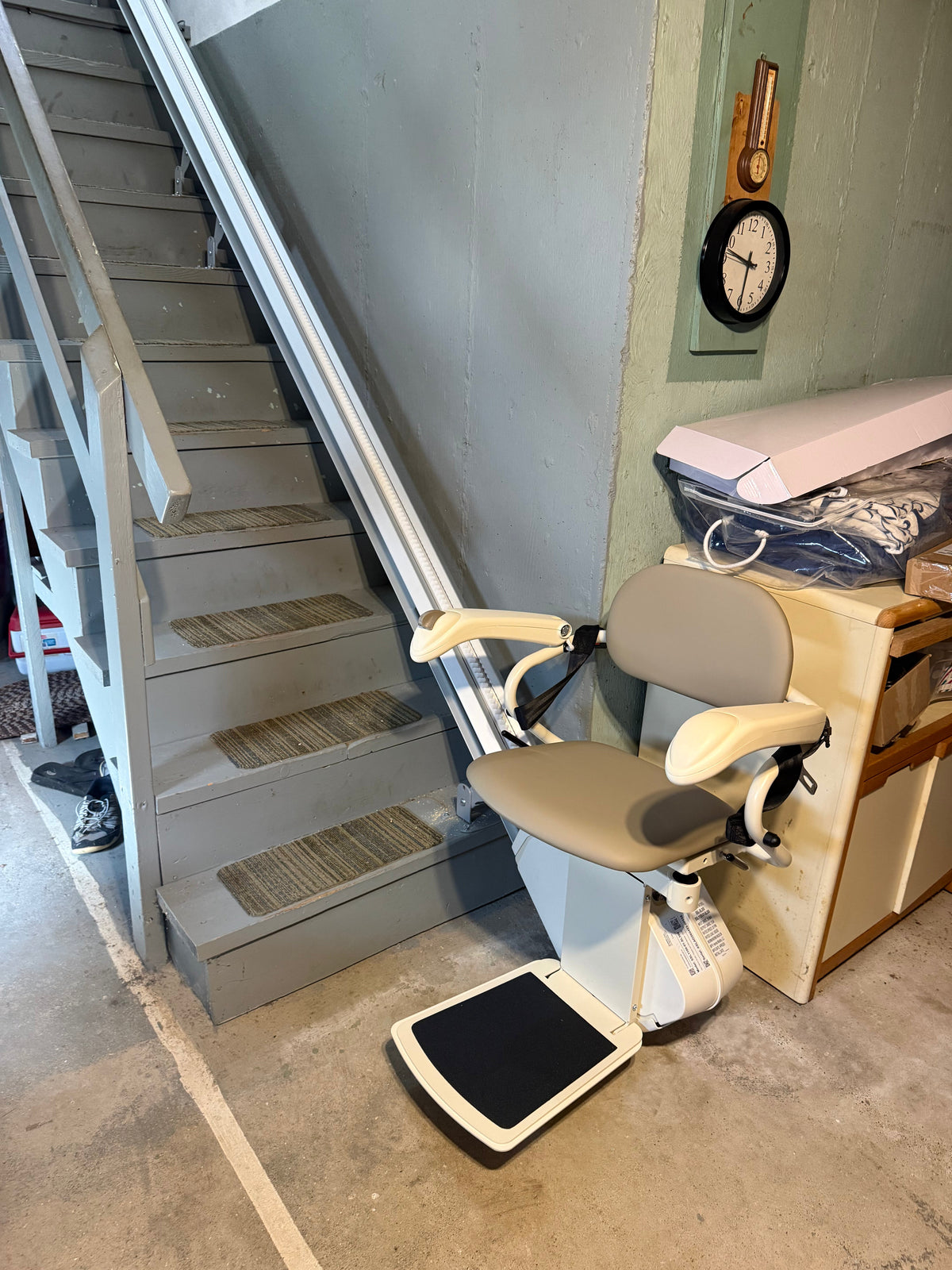
Harmar SL300 Pinnacle Stairlift Installed in Easthampton, MA: Easier Basement Access
USA Medical Supply installed a Harmar SL300 Pinnacle stairlift on a customer’s basement staircase in Easthampton, Massachusetts. This installation brings attention to an area of home accessibility that deserves careful consideration: the stairs connecting the main living area to the basement.
When people think about stairlifts, they often picture a staircase leading upstairs to a bedroom. Basement stairs can be just as important. Depending on the household, the lower level may contain laundry equipment, storage, a workshop, a finished family room, or another space the homeowner wants to continue using.
A stairlift provides a seated way to travel along the staircase. Choosing one involves more than selecting a chair, however. The equipment must suit the stairs, the surrounding space, and the person who will use it.
For homeowners researching basement stairlift installation in Easthampton, MA, this project offers a useful starting point for understanding the questions to ask.
Our Easthampton Basement Stairlift Installation
This completed USA Medical Supply project involved the following:
| Project Detail | Installation |
|---|---|
| Community | Easthampton, Massachusetts |
| Location within the home | Basement staircase |
| Manufacturer | Harmar |
| Model | Pinnacle SL300 |
| Installation company | USA Medical Supply |
The project’s focus was access between the home’s main floor and basement.
Every household uses its lower level differently. That is why a conversation about a basement stairlift should begin with the homeowner’s priorities: where they want to go, what makes the stairs difficult, and what support they need at each end.
The planning considerations below apply broadly to basement stairlift projects. Specific equipment options and installation details depend on the individual home.
Why Basement Access Deserves Attention
A basement can remain an important part of a home long after climbing the stairs becomes inconvenient or difficult.
Some homeowners want access to a familiar hobby area. Others want to spend time in a finished room, reach stored belongings, or participate in household routines. Even an occasional trip downstairs can matter when it helps someone continue using a space they value.
Consider a few possible situations:
-
A homeowner wants to visit a basement workshop.
-
A couple wants to continue spending time together in a downstairs family room.
-
Someone wants access to seasonal clothing or personal belongings.
-
A household wants to evaluate access to a lower-level laundry area.
-
A family is planning changes before basement stairs become a greater concern.
These are examples of reasons to explore accessibility equipment, rather than descriptions of this particular customer’s circumstances.
A useful question is: “What would easier basement access allow you to keep doing?”
The answer helps define the project. Access to a room used several times a day may call for a different conversation than access to storage visited once a month. The homeowner’s preferences should guide that discussion.
It is also worth considering alternatives alongside equipment. Would moving frequently used belongings upstairs help? Would relocating an activity make sense? Would a stairlift support the way the household wants to use the home?
An assessment gives the homeowner an opportunity to compare those choices with information about their actual staircase.
Understanding the Harmar Pinnacle SL300
The Harmar Pinnacle SL300 is a stairlift designed for straight indoor staircases. It has a published weight capacity of 300 pounds and carries a seated user along a rail.
Harmar lists features including a seat belt, a swivel seat with an interlock, a footrest obstruction sensor, and a drive system that does not require grease or lubrication. The manufacturer lists an approximately 11-inch folded width from the wallfor the standard configuration; optional equipment can change that measurement.
| Feature | Relevance to a Basement Installation |
|---|---|
| Straight indoor configuration | Intended for a compatible staircase inside the home |
| Seated travel | Provides an alternative to walking the stair flight |
| Folding components | Reduce the chair’s footprint when it is parked |
| Swivel seat | Supports entry and exit at the upper landing |
| Battery operation | Allows temporary operation during a household power interruption |
These features provide a starting point for discussion. They do not establish whether a particular basement staircase is suitable.
The decision still depends on the homeowner, the available space, and the complete installation layout.
Does a Straight Stairlift Fit Your Basement Stairs?
The word “basement” describes the destination. The shape of the staircase determines the type of rail system to evaluate.
A straight stairlift follows a continuous straight flight. A staircase with turns, winding steps, or changes in direction requires a different assessment. Harmar distinguishes straight stairlifts from curved systems designed to follow more complex layouts.
When contacting USA Medical Supply, describe the staircase as clearly as possible:
-
Does it travel directly from the main floor to the basement?
-
Is there a landing partway down?
-
Does the staircase turn?
-
Are there steps beyond the main flight?
-
Is there a door at the top or bottom?
-
Does the staircase open into a hallway or directly into a room?
These details help begin the conversation.
Photographs can also help explain the layout. A picture taken from a stable landing may show a doorway, a ceiling beam, or an unusual transition that is difficult to describe over the phone.
You do not need to determine the correct model yourself before asking for help. Start with the problem you want to solve and let the assessment establish which equipment deserves consideration.
For an Easthampton homeowner, that may mean evaluating an SL300 like the one installed in this project. Another home may call for a different configuration.
Basement Stairlift Measurements: More Than Staircase Width
A narrow-looking basement staircase does not automatically rule out a stairlift. A wide-looking staircase does not automatically establish that one will work.
The assessment needs to consider the space occupied by the equipment and the person riding it.
Harmar’s model-selection guidance identifies factors such as knee clearance, headroom, handrails, doorways, landing space, and room to swivel and transfer. Folded width is only one part of that evaluation.
This distinction matters when comparing product specifications online.
A folded measurement describes the equipment in a parked configuration. It does not tell you how much room a seated rider needs while traveling.
Before making a decision, homeowners should seek clear answers to practical questions:
Where will the rider’s knees and feet be?
The installed arrangement needs to accommodate the intended user throughout the route.
What happens near the ceiling?
Basement staircases may have overhead transitions that deserve close attention.
Where will the chair stop?
The stopping positions affect how the person gets on and off.
How will other household members use the stairs?
The conversation should include the people who continue walking the staircase.
What happens when nearby doors open?
A doorway must be considered in its operating position, not simply photographed while closed.
A careful assessment turns these questions into a plan for the actual home.
Pay Close Attention to the Top and Bottom Landings
Homeowners naturally focus on the stairs because that is where the lift travels. The areas at each end deserve equal attention.
Imagine arriving at the basement level. What happens next?
The person may need to stand, turn, reach a walking aid, or move toward a doorway. At the main floor, they may need to leave the chair and enter a hallway or kitchen.
Thinking through the entire sequence helps make the conversation more useful:
-
Approach the chair.
-
Position yourself to sit.
-
Get settled.
-
Travel between levels.
-
Leave the chair.
-
Continue toward the intended room or activity.
This exercise can reveal questions that a staircase measurement alone would miss.
For example, a storage shelf may occupy space that would be useful near the lower landing. A frequently used doorway may affect where equipment can be positioned. A household member may need room to assist.
Some installations may benefit from an optional folding rail where a lower rail extension would otherwise affect a walkway. Harmar offers that option on compatible configurations. Whether it is appropriate must be evaluated for the specific layout.
The objective is to understand how the installation will function during ordinary daily use.
Consider the Whole Journey Into the Basement
Reaching the basement landing is one part of reaching the room or activity that matters.
Ask what the homeowner will encounter after leaving the chair. Is the destination nearby? Is there room to move comfortably? Will assistance be available if needed?
A seated stairlift requires the user to transfer onto and off the chair. Someone who needs to remain in a wheelchair requires a conversation about a different type of access equipment or another arrangement. Harmar distinguishes seated stairlifts from platform lifts for this reason.
Useful discussion points include:
-
Whether the homeowner uses a mobility aid.
-
Where that aid will be needed.
-
Whether another person normally provides assistance.
-
Which basement activities remain practical.
-
Whether the household expects its needs to change.
Discussing these questions early can help avoid a purchase based solely on a product photograph or price.
The homeowner should also have a voice in the decision. An adult child or caregiver may organize the appointment, but the intended user’s comfort and preferences remain central.
The goal is a workable way to use the home that respects the person who will rely on the equipment.
What Professional Stairlift Installation Involves
A basement stairlift installation brings several tasks together.
Harmar describes a general installation process that includes measuring the stairs, securing the rail, installing the carriage and chair, establishing the charging connection, testing operation, and showing the customer how to use the equipment. Stairlift rails generally attach through brackets to the stair treads rather than the wall.
For the homeowner, several outcomes deserve attention:
A clear explanation of the layout.
You should understand where the equipment will sit and how the chair will be approached at both ends.
An explanation of the selected features.
Discuss the functions included with your equipment and any optional features in the proposal.
An opportunity to learn.
Installation day should include time for questions about normal operation.
Information to keep afterward.
Keep the owner’s manual, purchase paperwork, and service contact information together.
Ask about the expected installation schedule before making arrangements around work, family visits, or other appointments.
A project in another home can help you understand the possibilities. Your own assessment establishes the scope and timing for your staircase.
Basement Stairlifts and Household Power Outages
Power interruptions are a reasonable concern when considering equipment that travels between floors.
The SL300 uses batteries, allowing temporary operation when household electricity is unavailable. Harmar explains that outage performance depends on factors including battery age and rail length. It should not be treated as unlimited operation.
A useful installation-day discussion includes:
-
How normal charging works.
-
Where the chair should be parked.
-
How to recognize a charging concern.
-
What the manufacturer recommends during an outage.
-
Who to contact if the equipment does not operate as expected.
Keep those instructions with the other equipment paperwork so they are easy to find.
For a basement installation, it is also sensible to think about how household members will communicate if assistance is needed downstairs. That conversation can form part of the family’s broader planning.
Ask questions before the situation occurs. Understanding the equipment while everything is working normally is easier than trying to learn its functions during an interruption.
What Does a Basement Stairlift Cost in Easthampton?
The useful number is the installed price for your home, with the scope explained in writing.
A product advertisement may not tell you everything about the finished project. Staircase layout, equipment selection, rail requirements, optional features, and installation considerations can affect the proposal. Harmar recommends working with a qualified dealer to establish the appropriate equipment and installed price.
When reviewing an estimate, ask:
-
Which model is included?
-
Is the equipment new or previously owned?
-
What rail configuration is specified?
-
Are any optional features included?
-
Does the total include installation?
-
Are any separate preparations necessary?
-
What manufacturer warranty applies?
-
What labor or service coverage is included?
-
How will future service be arranged?
A written proposal makes those answers easier to compare.
Ask about financing options if spreading out the purchase would help your household budget. USA Medical Supply advertises financing options alongside its home accessibility services.
USA Medical Supply does not bill Medicare or health insurance for stairlift installations. If you are exploring outside financial assistance, discuss the requirements with the relevant organization before making commitments.
The next step is an assessment that connects the equipment recommendation to the home, the intended user, and the total project cost.
Why Local Support Matters After Installation
A stairlift purchase creates an ongoing relationship with equipment that may become part of everyday life.
That makes support worth discussing before the installation.
Homeowners should know who will answer operating questions, arrange an inspection, or help when the chair behaves differently than expected.
Harmar recommends considering an authorized dealer’s assessment process, installation experience, and ongoing support when choosing where to purchase a stairlift.
USA Medical Supply is listed in Harmar’s dealer directory, with its West Springfield location and stairlift services identified.
For an Easthampton family, practical questions include:
-
Where is the company located?
-
Which number should we call for service?
-
What information should we have available?
-
How are service appointments arranged?
-
What does our purchase agreement cover?
Those answers help set expectations.
Keep a copy of the equipment model and identifying information somewhere accessible. If a question arises later, having the paperwork nearby can make the conversation more efficient.
Choosing equipment and choosing a provider belong in the same decision.
Preparing for a Free Basement Stairlift Assessment
You do not need to prepare a technical report before contacting USA Medical Supply.
A short description of the staircase and your priorities is a useful beginning.
Before the appointment, consider writing down:
Your main reason for exploring a stairlift.
Explain what you want to continue doing in the basement.
Your questions about the stairs.
Mention doorways, narrow areas, overhead features, or anything else you think may matter.
Who will use the equipment.
Include everyone expected to ride it so the conversation reflects the household’s needs.
Your preferred timing.
Explain whether you are planning ahead or working toward a particular date.
Your budget questions.
Discuss the information you need to evaluate the purchase.
If a family member normally helps with decisions or daily activities, consider including that person in the appointment.
You can also identify items near the staircase that may need discussion, such as shelving, stored belongings, or furniture. There is no need to move heavy objects before receiving guidance.
A productive assessment is a conversation about the home and the homeowner. It gives both sides an opportunity to understand the problem before settling on equipment.
Everyday Use: Learn the Equipment Before Relying on It
Learning to use a stairlift deserves time and attention.
The SL300 owner’s manual covers operation and cautions, including following the specified load limit, keeping obstructions clear, and using the equipment for its intended purpose. It specifically identifies the lift as equipment for people, rather than freight.
That matters in a basement setting, where homeowners may associate the stairs with laundry, storage bins, or household supplies.
Plan separately for moving those items. A seated stairlift should not become a way to send baskets, boxes, pets, or other loads between floors.
During instruction, ask the installer to explain any function you do not understand. If another household member will help operate the equipment, include that person.
Keep the instructions accessible and revisit them when necessary. There is no advantage to guessing how a control works.
A good question to ask before the installer leaves is: “Can we go through the normal routine once more?”
Familiarity develops through clear instruction and appropriate use.
Caring for a Basement Stairlift
A basement installation deserves the same attention to care as equipment elsewhere in the home.
Follow the instructions supplied with the installed unit. The SL300 manual addresses charging, cleaning, and professional inspection, and recommends an annual inspection within its maintenance guidance.
General housekeeping around the equipment also matters. Avoid allowing stored belongings to accumulate in areas needed for normal access.
Harmar’s care guidance separates routine owner tasks from technical repairs and adjustments. Cleaning does not replace professional inspection.
If the stairlift begins making unfamiliar sounds, moves differently, repeatedly signals a fault, or has a visibly loose component, contact the service provider. Harmar identifies these as reasons to seek professional attention.
When calling, describe:
-
What you observed.
-
When it started.
-
Whether it happens consistently.
-
Whether a light or sound accompanies it.
-
The equipment model.
Clear observations help start the service conversation. Repairs and adjustments should be handled by the appropriate technician.
Revisit the Plan When Household Needs Change
An installation should be considered in the context of the person using it over time.
A homeowner’s preferences, transfer ability, assistance needs, or living arrangements may change. The right response is to reassess how the equipment fits those circumstances.
Harmar notes that a stairlift can remain mechanically functional while no longer meeting a user’s needs. A professional review can help determine whether adjustments, different equipment, or another access arrangement deserves consideration.
This does not mean trying to predict every future possibility at the initial appointment.
It means keeping communication open.
If getting on or off becomes more difficult, or the household begins using the basement differently, raise the issue. If another person starts using the equipment, discuss that change as well.
The equipment serves the homeowner’s life. Reviewing the arrangement when circumstances change helps keep that purpose in view.
Serving Easthampton and Nearby Western Massachusetts Communities
This basement installation is one example of USA Medical Supply’s work helping local homeowners explore access between floors.
Our business is based in West Springfield, and our published service area includes Easthampton, along with nearby communities such as Northampton, Southampton, Holyoke, and South Hadley.
Whether you are researching a basement staircase or another area of the home, begin by explaining the access problem you want to address.
Some households already know which product they want to discuss. Others need help understanding the available categories.
Both are reasonable starting points.
You can also explore our Harmar and Access BDD Stairlift FAQ Guide for additional questions to bring to an assessment.
Frequently Asked Questions About Basement Stairlifts in Easthampton
Can a stairlift be installed on basement stairs?
Yes, a suitable staircase can accommodate a basement stairlift. This Easthampton project involved a Harmar Pinnacle SL300 installed by USA Medical Supply. Another home requires its own assessment to determine an appropriate arrangement.
Is the Harmar SL300 called the Pinnacle?
Yes. Harmar identifies this model as the Pinnacle SL300. It belongs to the manufacturer’s straight indoor stairlift range.
What is the SL300’s weight capacity?
Harmar lists a 300-pound maximum capacity. Capacity is one consideration; the assessment should also address the intended user’s fit and the space available.
Will an SL300 fit a narrow basement staircase?
That requires measurements and an evaluation of the rider’s clearance. A folded-width specification alone does not establish suitability. Doorways, headroom, landings, and the occupied chair position also matter.
Does the staircase need a folding rail?
Some layouts may benefit from one, especially where a lower rail extension would affect a doorway or walkway. The need depends on the proposed installation. A folding rail should be discussed as a project-specific option.
Will a stairlift work during a power outage?
The SL300’s batteries allow temporary operation during an interruption. Available travel depends on operating conditions and battery condition. Ask for instructions specific to your equipment and installation.
Can someone ride it while remaining in a wheelchair?
A seated stairlift requires a transfer to its chair. Someone who needs to remain in a wheelchair should discuss a platform lift or another suitable access approach.
Can I use it to transport laundry or storage boxes?
The SL300 is intended to transport people within its rated capacity. Its manual says not to use it for freight. Arrange another method for moving household loads between levels.
How quickly can a basement stairlift be installed?
Ask for a timeline after the home and equipment requirements have been reviewed. Availability, configuration, necessary preparations, and scheduling affect the answer. A completed project elsewhere does not establish the timeline for your home.
Does USA Medical Supply offer free assessments in Easthampton?
Yes. Contact our team to discuss your Easthampton home and arrange the next steps for a free, no-obligation accessibility assessment.
Schedule Your Free Basement Stairlift Assessment
If basement stairs are making part of your home harder to reach, start with a conversation about your options.
USA Medical Supply’s Harmar SL300 Pinnacle installation in Easthampton, Massachusetts, demonstrates one application of a straight indoor stairlift. Your assessment will help establish what makes sense for your staircase and household.
Tell us where access is needed, what you want to keep doing, and which questions you would like answered.
Schedule Your Free Home Assessment
USA Medical Supply Inc.
1779 Riverdale Street
West Springfield, MA 01089
Call: 413-733-7843
Text: 413-200-4191
Email: info@usamedicalsupply.com
Website: USAMedicalSupply.com
Showroom Hours: Monday–Friday, 9 a.m.–6 p.m.; Saturday, 9 a.m.–2 p.m.
Local equipment guidance, professional installation, and service for Easthampton and surrounding Western Massachusetts communities.
Bibliography and Sources
Manufacturer specifications and available options can change. Confirm the configuration, warranty terms, and installation requirements for the equipment being purchased.
-
Harmar. SL300 Pinnacle Stairlifts: Product Features and Specifications.
-
Harmar. Pinnacle SL300 Stairlift Owner’s Manual. Revision dated March 25, 2024.
-
Harmar. Stairlift Buyer’s Guide: Costs, Types, and Installation.
-
Harmar. Stairlift Buyers Guide: Pinnacle, Summit, and Helix.
-
Harmar. Stairlift Buyer’s Guide: How to Choose the Right Lift for Your Home.
-
Harmar. Stairlift and Home Elevator Safety FAQs: Maintenance, Care, and Use.
-
USA Medical Supply. Company Website and Service Area.
-
USA Medical Supply. The Ultimate Stairlift Guide for Western Massachusetts.
-
USA Medical Supply. Free Home Accessibility Assessment.
-
USA Medical Supply. Project information supplied for this article: Harmar Pinnacle SL300 installed on a customer’s basement staircase in Easthampton, Massachusetts.
Web sources accessed November 2, 2026.