
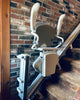
Stairlift FAQs 2026: Harmar & Access BDD Complete Guide
, by Richard Spafford, 26 min reading time
, by Richard Spafford, 26 min reading time
Updated October 2026 | USA Medical Supply — West Springfield, Massachusetts
When stairs become difficult, uncomfortable, or unsafe, one of the biggest questions families face is simple:
What do we do now?
For many people, the answer does not have to be moving to another home or giving up access to an entire floor.
A properly selected stairlift can make it possible to continue using the home you already know and love while reducing the physical demands of climbing stairs.
At USA Medical Supply in West Springfield, Massachusetts, we specialize in stairlift solutions from Harmar and Access BDD. We sell, install, service and support straight, curved, heavy-duty and outdoor stairlift configurations, along with new, used and rental options where available.
This guide updates and greatly expands our original 2025 stairlift FAQ. Instead of giving generic answers, we are focusing on the actual Harmar and Access BDD products available today.
That matters because stairlift technology has continued to evolve.
Current options include compact straight stairlifts such as the Harmar Pinnacle SL300 and SL600, the 600-pound-capacity Harmar SL600HD, the custom Harmar Helix, Harmar's modular UP Stairlift, the Access BDD HomeGlide and HomeGlide Extra, the outdoor HomeGlide Outdoor, and the advanced Access BDD Flow X for curved and exceptionally narrow staircases.
CDC data also reinforces why home mobility deserves serious attention: falls remain a leading cause of injury among adults age 65 and older. A stairlift is not a substitute for a complete fall-prevention plan, but for someone who has difficulty safely climbing stairs, eliminating the need to repeatedly walk that staircase may remove one significant challenge inside the home.
For a standard straight indoor staircase, consider the Harmar Pinnacle SL300, Harmar Pinnacle SL600, Access BDD HomeGlide or HomeGlide Extra.
For a higher weight capacity, the Harmar Pinnacle SL600HD supports up to 600 pounds.
For a curved staircase, staircase with landings or multiple turns, consider the Access BDD Flow X, Harmar Helix or Harmar UP Stairlift.
For an especially narrow curved staircase, the Access BDD Flow X is particularly impressive because its Advanced Swivel and Leveling technology allows installation on certain staircases as narrow as 24 inches.
For straight outdoor stairs, options include the Harmar Summit SL350OD and Access BDD HomeGlide Outdoor.
For a homeowner who wants an especially compact premium straight lift, the Harmar Pinnacle SL600 folds to approximately 10.5 inches from the wall when folded.
For a homeowner who wants additional powered comfort features on a straight staircase, the HomeGlide Extra adds features such as a powered swivel and powered linked footrest.
Exact suitability always depends on the staircase and the person using the lift.
A stairlift is a motorized chair that travels along a rail attached to the staircase.
The person sits in the chair, secures the seatbelt and uses a simple control to travel between floors.
Most residential stairlifts include a seat, backrest, armrests, footrest, safety belt, rail, drive system, controls and safety sensors.
The rail is generally attached to the stair treads rather than the wall.
That is one of the biggest misconceptions we hear from homeowners.
You usually do not need major wall construction to install a stairlift.
Access BDD specifically states that its HomeGlide and Flow X systems are attached to the staircase rather than the wall. Harmar stairlifts are similarly mounted to the stairs.
A stairlift may be worth considering when someone can still transfer safely into and out of a seated position but finds climbing stairs difficult, painful, exhausting or unsafe.
Customers frequently investigate stairlifts because of changes involving balance, strength, endurance, arthritis, recovery from surgery or injury, progressive mobility limitations, or simply increased concern about using stairs.
A stairlift can also be useful when someone wants to continue living in a multi-story home instead of restricting daily life to one floor.
The important question is not simply someone's age.
It is whether that person can safely use the staircase.
Modern stairlifts are engineered with multiple layers of safety protection.
Depending on the model, these can include seatbelts, obstruction sensors, constant-pressure controls, swivel-seat interlocks, overspeed protection, automatic stop systems, key locks and chassis or footrest sensors.
For example, the Harmar Pinnacle SL600 includes a retractable seatbelt, overspeed brake, swivel-seat interlock and obstruction sensors.
The Access BDD Flow X includes a one-handed seatbelt with seatbelt detection, armrest detection and automatic stopping technology.
Safety still depends on using the lift correctly, keeping the staircase clear and maintaining the equipment properly.
A straight stairlift is designed for a staircase that travels from one level to another without turns, bends or intermediate landings that the chair must navigate.
A curved stairlift follows a staircase with bends, turns, curves, intermediate landings or more complex geometry.
Straight lifts typically use standardized rail sections.
Curved systems require a rail designed or configured around the staircase.
Among the products we work with, the Access BDD Flow X, Harmar Helix and Harmar UP Stairlift can address curved staircase applications.
Absolutely.
That is exactly what curved stairlifts are designed to do.
The rail can follow bends, turns and landings so the user does not have to transfer from one chair to another halfway up the staircase.
The Access BDD Flow X uses a custom single-rail system and Advanced Swivel and Leveling technology.
The Harmar Helix uses a custom-fabricated rail designed specifically for the staircase.
Harmar's UP Stairlift takes a different approach by using modular rail components that can be configured for curved staircases.
There is no single "best" approach for every house. The staircase geometry, available space, user's dimensions and desired features all need to be considered.
This is one area where measuring the staircase professionally becomes extremely important.
For very narrow or complex staircases, the Access BDD Flow X deserves particular consideration.
Access BDD states that Flow X can be installed on certain staircases as narrow as 24 inches because the chair can rotate while traveling using its Advanced Swivel and Leveling technology.
That rotation helps position the rider more efficiently through tight sections of the staircase.
For straight stairs, the Access BDD HomeGlide can accommodate certain staircases approximately 29 inches wide, while Harmar's compact Pinnacle designs also conserve substantial space when folded.
Do not assume your staircase is too narrow until it has actually been measured.
Capacity depends heavily on the model.
The Harmar Pinnacle SL300 supports up to 300 pounds.
The Harmar Pinnacle SL600 supports up to 350 pounds.
The Harmar Pinnacle SL600HD supports up to an impressive 600 pounds and is specifically designed as a heavy-duty stairlift.
The Harmar Helix supports up to 350 pounds.
The Access BDD Flow X supports up to 275 pounds.
The Access BDD HomeGlide can support up to approximately 350 pounds on qualifying staircase angles, with permitted capacity varying according to staircase angle and configuration.
Weight capacity should never be estimated. The user and staircase must both fall within the manufacturer's specifications for the particular installation.
For straight staircases, the standout option in the Harmar and Access BDD families is the Harmar Pinnacle SL600HD.
It is rated for users up to 600 pounds.
Harmar equips it with a wider, high-backed chair, reinforced footrest and stationary armrests designed to provide increased stability.
Heavy-duty installations require more than simply checking someone's weight. Seat dimensions, transfer ability, staircase width, rail length and landing space should all be evaluated before choosing a lift.
Many will—but not every stairlift operates the same way.
The Harmar Pinnacle SL300 and SL600 use battery systems that remain charged while household power is available. Harmar states that its Pinnacle straight lifts can provide up to 60 trips during a power outage, depending on conditions and battery health.
The Access BDD HomeGlide is also battery operated and can continue functioning during a household power failure.
However, this is exactly why customers should not assume every model has identical power-outage capabilities. For example, Harmar's Summit SL350OD outdoor stairlift uses an AC-powered system.
We discuss power requirements during the assessment so you know exactly what will happen if electricity goes out.
No.
Battery-operated stairlifts use household electricity primarily to keep their batteries charged.
They are not continuously consuming the amount of electricity associated with large household appliances.
The more important requirement is keeping the stairlift parked where it can charge properly according to the manufacturer's instructions.
Battery life depends on usage, charging conditions, temperature and battery condition.
Access BDD says stairlift batteries commonly last approximately two to five years, depending on care and usage.
Rather than replacing batteries according to the calendar alone, we recommend having the stairlift inspected and responding promptly to charging warnings or changes in performance.
Keeping a battery-powered stairlift properly parked at its charging location is particularly important.
Generally, no.
Residential stairlift rails are normally secured to the staircase itself.
That means installation usually does not require opening the wall or performing major structural construction.
This also makes future removal considerably simpler.
A professionally installed stairlift requires mounting points in the staircase, so it would be misleading to say installation leaves absolutely no evidence behind.
However, stairlifts do not normally require major reconstruction.
Once removed, small mounting holes can generally be repaired much more easily than a major structural home modification.
This is another reason we prefer professional installation instead of improvised do-it-yourself installations.
Straight stairlifts are generally the quickest installations.
Access BDD states that HomeGlide installations can typically be completed within a few hours.
A curved stairlift requires additional work because the rail must precisely follow the staircase. Access BDD says a Flow X installation typically requires approximately half a day once the custom equipment is ready.
Actual installation time depends on staircase complexity, site conditions and options being installed.
This depends heavily on the technology.
Traditional custom curved lifts require the staircase to be measured and the rail manufactured to those dimensions.
The Harmar Helix is a custom-fabricated system.
The Access BDD Flow X is also tailored to the staircase.
For situations where speed is especially important, Harmar offers the UP Stairlift, which uses modular rail components and may allow much faster turnaround depending on dealer inventory and staircase configuration.
That can be particularly valuable when someone is unexpectedly returning home from rehabilitation or a hospital and suddenly cannot safely use the stairs.
Often, yes.
A folding rail may solve this problem.
Instead of leaving the bottom section of the rail permanently extended across a hallway or doorway, the lower portion can fold upward when it is not needed.
For example, the Harmar Pinnacle SL600 offers an automatic folding rail option.
The Access BDD HomeGlide also offers an automatic folding rail option.
During an assessment, we pay close attention to doors, hallways and walking paths at both ends of the staircase because keeping those areas clear can be just as important as fitting the lift itself.
At the upper landing, you generally do not want someone stepping directly off the chair while facing an open staircase.
A swivel seat turns the rider toward the landing so they can enter or exit from a safer orientation.
Depending on the model, swiveling may be manual or powered.
For example, the Access BDD HomeGlide Extra includes a powered swivel feature, while premium Harmar configurations can also offer powered swivel options.
The proper choice depends on the user's leg strength, hand function and ability to rotate the chair manually.
Controls are intentionally designed to require very little effort.
The Harmar Pinnacle SL600 uses an ergonomic control located on the armrest.
Access BDD uses soft-touch joystick controls on its HomeGlide and Flow X.
This may sound like a small detail, but it is one reason we encourage customers to actually test a stairlift before purchasing whenever possible.
What looks easy on paper should also feel easy to the person who will use it every day.
Yes, assuming both people fall within the stairlift's physical and weight specifications and can safely transfer into and out of the chair.
Call/send controls also allow someone to send an empty chair to the other floor.
This can be particularly useful in households where two people use the same stairlift.
Many models can be equipped with or include a key lock, helping prevent unauthorized use.
That is especially useful when children or grandchildren visit.
A stairlift should still be treated as powered mobility equipment rather than a toy.
Modern stairlifts include obstruction detection systems.
Sensors located around areas such as the footrest or chassis can stop the lift when an obstruction is detected.
That does not mean the staircase should become a storage area.
Keeping stairs clear remains important for both stairlift operation and everyone else using the staircase.
Yes—but you need a stairlift specifically approved for outdoor use.
Two options we work with are the Harmar Summit SL350OD and Access BDD HomeGlide Outdoor.
The Harmar SL350OD uses an aluminum track, marine-grade vinyl seating and protective covers and is specified for temperatures from approximately 0°F to 125°F.
The Access BDD HomeGlide Outdoor uses outdoor-protected components and a protective cover and is certified on its current U.S. product page for temperatures from approximately 5°F to 122°F.
That temperature information matters in New England. During unusually extreme winter conditions, follow the manufacturer's operating limitations rather than assuming an outdoor stairlift can operate at any temperature.
Some curved systems can be configured for outdoor applications.
For example, Harmar lists an outdoor package as an available option for the Helix.
Outdoor curved installations require careful evaluation because weather exposure, drainage, electrical supply and extreme temperatures all become part of the project.
The Flow X is one of the most technologically advanced stairlifts in the Access BDD line.
Its defining feature is Advanced Swivel and Leveling technology, often referred to as ASL.
Instead of simply riding in one fixed orientation, the chair can rotate while traveling through the staircase.
That allows the rider's position to adapt to curves and narrow sections.
Access BDD says the Flow X can accommodate some staircases as narrow as 24 inches.
It uses a single rail, has a 275-pound capacity, includes seatbelt detection and can be configured for straight or curved staircases.
For complicated or narrow staircases, Flow X is one of the first products we consider during an assessment.
Both are Access BDD straight-staircase solutions.
The standard HomeGlide provides the core stairlift system with a slim aluminum rail, retractable seatbelt, joystick and automatic stopping features.
The HomeGlide Extra adds comfort and convenience options including a powered swivel, powered linked footrest, selectable seat heights and key-lock capability.
Someone with difficulty bending down to unfold a footrest or manually rotating a seat may particularly appreciate the Extra configuration.
Both are excellent straight stairlifts, but they are designed for somewhat different buyers.
The Pinnacle SL300 supports up to 300 pounds and provides a compact, straightforward Harmar stairlift solution.
The Pinnacle SL600 increases capacity to 350 pounds and adds premium features and available options.
The SL600 also folds to approximately 10.5 inches from the wall and uses Harmar's lubrication-free helical worm-gear drive system.
If both lifts work with the staircase and user's measurements, comfort, options and budget usually help determine which is the better fit.
The Harmar Helix is Harmar's custom curved stairlift.
Its rail is fabricated to follow the unique shape of the customer's staircase.
It supports up to 350 pounds and can accommodate curves, landings and tight turns.
Harmar lists obstruction sensors, swivel-seat interlocks, constant-pressure controls, a seatbelt and overspeed protection among its safety features.
For homeowners who want a purpose-built curved Harmar system, the Helix is an important option.
This may be the most common question we receive—and one of the most difficult to answer responsibly without seeing the staircase.
A straight stairlift usually costs substantially less than a custom curved system.
Price is affected by rail length, staircase configuration, weight capacity, powered options, folding rails, outdoor packages, electrical requirements and installation conditions.
Curved stairs must be evaluated individually because the rail itself is configured for the home.
Rather than advertising a low starting price that may have little connection to the actual project, USA Medical Supply offers free stairlift assessments so we can provide a quote based on the staircase and user's needs.
Original Medicare generally does not cover residential stairlifts.
CMS has specifically discussed stairway elevators and stairlifts as items that are generally not considered medical equipment for Medicare purposes because their primary and customary use is not considered medical.
This is very different from certain covered durable medical equipment such as walkers, hospital beds and qualifying wheelchairs.
Coverage rules can differ under private programs and individual Medicare Advantage plans, so customers should always contact their insurer directly rather than assuming coverage either way.
Yes, and this is something Massachusetts residents should investigate.
The Massachusetts Home Modification Loan Program, administered through MassAbility and its partners, offers qualifying residents zero-interest deferred-payment loans for accessibility improvements.
Massachusetts specifically identifies stair-lifts among the types of eligible home modifications.
Eligibility requirements apply, including household and documentation requirements.
This can be a valuable resource for families trying to make a home accessible without paying the entire project cost immediately.
Potentially.
IRS guidance allows certain capital expenses for equipment or home improvements needed for medical care to be considered medical expenses when applicable requirements are met.
Whether a particular stairlift installation qualifies—and how much may qualify—depends on individual tax circumstances.
For that reason, we recommend discussing the installation with a qualified tax professional rather than treating every stairlift purchase as automatically deductible.
Yes.
USA Medical Supply offers stairlift rental options, subject to equipment availability and the staircase configuration.
Rentals can make sense for temporary mobility limitations, recovery after surgery, rehabilitation, visiting family members or situations where the future need is uncertain.
We also offer rent-to-own options on qualifying stairlift arrangements.
Because curved stairlifts are customized to the staircase, rental availability is much more dependent on the particular installation than it is with standard straight stairlifts.
They can be.
A professionally inspected and refurbished straight stairlift may provide excellent value.
The important distinction is between purchasing a stairlift that has been properly inspected, tested and installed by a company that will support it versus buying unidentified equipment privately with no knowledge of its history.
With used equipment, ask about its condition, battery condition, parts availability, warranty, installation and who will service the unit if something goes wrong.
Yes.
A professionally installed stairlift can generally be removed if it is no longer needed.
Straight rail systems are particularly straightforward to remove.
A custom curved rail was manufactured for a particular staircase, which makes relocation or reuse more complicated.
If a stairlift is only expected to be needed temporarily, tell us during the assessment. That may change which solution makes the most sense financially.
Possibly.
Straight stairlifts have a much better chance of being relocated because their rail systems are relatively standardized.
The new staircase still has to fall within the model's operating requirements.
Curved stairlifts are different because the rail geometry is based on the original staircase.
In many cases, moving a custom curved system is impractical or requires substantial new components.
Regular inspection and preventative maintenance help identify wear, battery issues, loose components or other problems before they interfere with operation.
Access BDD recommends annual servicing, with more frequent checks appropriate for very heavily used equipment.
You should also contact your service provider whenever you notice unusual sounds, slower operation, charging warnings, intermittent stopping or other changes in performance.
We strongly recommend professional assessment and installation.
A stairlift is carrying a person above a staircase.
Correct rail positioning, mounting, clearances, charging, upper-landing safety, seat height, stopping positions and obstruction clearances are not details we recommend leaving to guesswork.
Harmar itself emphasizes working through qualified dealers for installation and service.
Yes.
USA Medical Supply has stairlifts available to experience at our showroom at:
USA Medical Supply
1779 Riverdale Street
West Springfield, MA 01089
Trying a stairlift before purchasing can be extremely valuable.
You can evaluate seat comfort, controls, speed, swiveling, folding components and how easy it is to get into and out of the chair.
We have demonstrated Harmar and Access BDD stairlift products in our showroom, allowing customers to experience the difference rather than choosing solely from photographs or specifications.
We sell both because they solve different problems extremely well.
Harmar provides an exceptionally broad range of configurations, including compact Pinnacle straight lifts, the 600-pound SL600HD, outdoor equipment, and custom or modular curved solutions.
Access BDD provides the HomeGlide family for straight staircases and the highly sophisticated Flow X for narrow and curved applications.
Sometimes the correct answer is obvious after measuring the staircase.
Other times, two products will technically fit and the decision comes down to comfort, appearance, controls, powered features and budget.
That is why we prefer to fit the stairlift to the person and home rather than forcing every customer into the same model.
A good stairlift assessment should answer much more than "Will it fit?"
You should know which model is being recommended and why, its maximum capacity for your staircase, where the rail will begin and end, whether a folding rail is necessary, whether the seat will swivel safely at the upper landing, what electrical supply is required, what happens during a power failure, what warranty applies, who performs service, what maintenance is recommended and what the complete installed cost will be.
The person using the stairlift should be part of the conversation whenever possible.
A staircase can fit a stairlift perfectly while the chair itself is wrong for the individual.
Both pieces matter.
A stairlift is a combination of a person and a staircase.
We evaluate both.
Important measurements include staircase width, total travel, incline, upper and lower landing space, doorways, trim, handrails and possible obstructions.
For the user, we may also need to consider weight, seated dimensions, knee clearance, transfer ability, hand function and whether powered swivel or powered footrest features would make operation easier.
With curved stairlifts, accurate surveying becomes even more important because the rail follows the staircase geometry.
Shopping only by price.
The cheapest equipment is not a bargain if it is uncomfortable, difficult to operate, poorly fitted to the staircase or impossible to have serviced locally.
A stairlift is something a person may depend upon every day.
Ask who is going to install it.
Ask who answers the phone if it stops working.
Ask whether replacement parts are available.
Ask about batteries.
Ask about warranty coverage.
Ask whether the company services what it sells.
Those questions matter just as much as the number printed on the estimate.
Stairlifts are not ordinary products that are simply delivered in a box.
The process includes measuring, selecting the correct equipment, installation, adjustment, user training and future service.
When a mobility product becomes part of someone's daily access to their bedroom, bathroom or main living area, having local service support becomes extremely valuable.
USA Medical Supply is located in West Springfield, Massachusetts, where customers can speak with our team, see stairlift equipment and arrange an in-home assessment.
Start with an assessment.
You do not need to know which model you need.
You do not need to measure every angle yourself.
And you do not have to understand the differences between every stairlift before calling us.
That is our job.
We will look at the staircase, talk with the person who will actually use the lift and determine which Harmar or Access BDD stairlift makes the most sense.
USA Medical Supply
1779 Riverdale Street
West Springfield, MA 01089
Call: 413-733-7843
Text: 413-200-4191
Whether you are researching a simple straight stairlift, a narrow curved staircase, an outdoor lift or a heavy-duty 600-pound solution, we can help you determine what will actually work in your home.
Your stairs should not decide which parts of your home you are allowed to use.
This guide intentionally focuses exclusively on the stairlift brands USA Medical Supply wants to feature:
Harmar: Pinnacle SL300, Pinnacle SL600, Pinnacle SL600HD, Summit SL350OD, Helix Curved Stairlift and UP Curved Modular Stairlift.
Access BDD: HomeGlide, HomeGlide Extra, HomeGlide Outdoor and Flow X.
Product specifications and available options can change. Final model selection and specifications should always be confirmed at the time of assessment and ordering.
Harmar Mobility. Straight Stairlifts. Current Harmar product overview covering the Pinnacle SL300, SL600, SL600HD and Summit models.
Harmar Mobility. SL300 Pinnacle Stairlifts. Manufacturer specifications and product features.
Harmar Mobility. SL600 Pinnacle Premium Stairlifts. Manufacturer specifications, safety features, folded width, power-outage operation and warranty information.
Harmar Mobility. SL600HD Pinnacle Heavy-Duty Stairlift. Manufacturer specifications for Harmar's 600-pound-capacity straight stairlift.
Harmar Mobility. Helix Curved Stairlifts. Manufacturer specifications, capacity, safety features, rail design and outdoor-package information.
Harmar Mobility. UP Stairlift Curved Modular Stairlift. Manufacturer description of Harmar's modular curved stairlift and 275-pound capacity.
Harmar Mobility. SL350OD Summit Outdoor Stairlifts. Manufacturer specifications including capacity, operating system, weather protection and operating-temperature information.
Access BDD. Stair Lifts — U.S. Current Access BDD stairlift lineup including Flow X, HomeGlide, HomeGlide Extra and HomeGlide Outdoor.
Access BDD. HomeGlide Stair Lift. Current U.S. manufacturer specifications for HomeGlide, HomeGlide Extra, folding rail, powered swivel, powered footrest, dimensions and weight capacity.
Access BDD. Flow X Stair Lift. Current U.S. specifications covering Advanced Swivel and Leveling technology, 24-inch staircase capability, 275-pound capacity and safety systems.
Access BDD. HomeGlide Outdoor Stair Lift. Current U.S. manufacturer information regarding outdoor protection, capacity, controls and operating-temperature range.
Access BDD. Stair Lift FAQ Hub. Manufacturer guidance regarding installation, batteries, servicing, power use and general stairlift ownership.
USA Medical Supply. Comprehensive Guide to Stairlifts: Your Questions Answered. Original April 29, 2025 USA Medical Supply FAQ used as the foundation for this substantially updated edition.
USA Medical Supply. Stairlifts Collection. Current information regarding Harmar and Access BDD stairlifts, free assessments, purchases, used equipment and rental options.
USA Medical Supply. Try a Stairlift Before You Buy. Showroom information for stairlift demonstrations in West Springfield, Massachusetts.
Centers for Disease Control and Prevention. About Older Adult Fall Prevention and Facts About Older Adult Falls.Current 2026 fall-prevention information for adults 65 and older.
Centers for Medicare & Medicaid Services. Medicare coverage guidance concerning stairway elevators/stairlifts and durable medical equipment.
MassAbility / Commonwealth of Massachusetts. Home Modification Loan Program. Current Massachusetts program information identifying stair-lifts among eligible accessibility modifications for qualifying applicants.
Internal Revenue Service. Tax Guide for Seniors / Medical and Dental Expenses. IRS guidance regarding qualifying medical capital expenses and home improvements.