
Therafirm and Knit-Rite Compression Stockings: Why Professional Measuring, Fitting, and Personal Assistance Matter
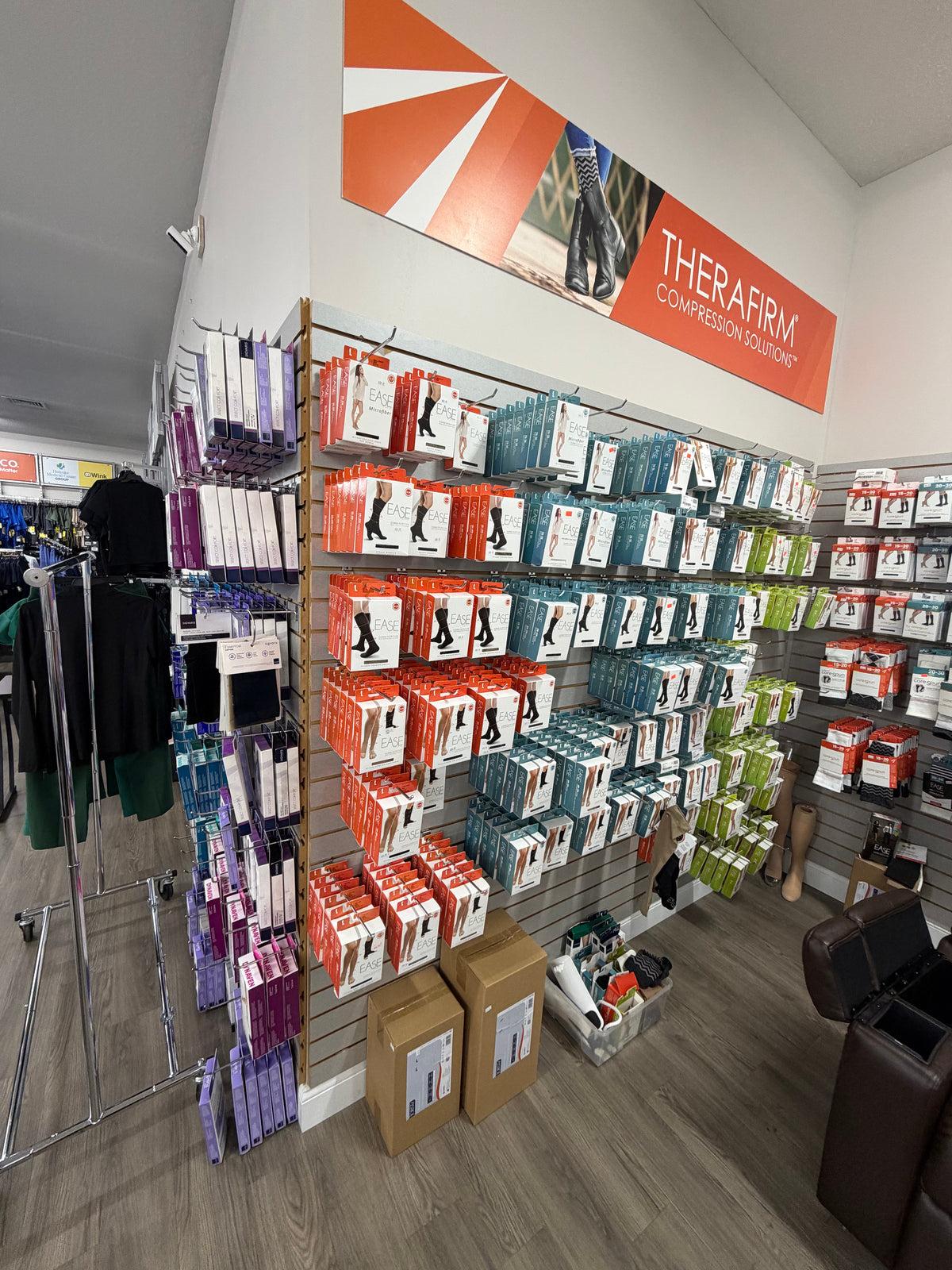
Therafirm and Knit-Rite Compression Stockings: Why Professional Measuring, Fitting, and Personal Assistance Matter
Buying compression stockings should not feel like a guessing game.
Yet that is exactly what happens to many people. They are told to buy compression stockings, walk into a store or search online, and suddenly face a confusing list of numbers, sizes, lengths, fabrics, and compression levels.
Should you buy knee-high or thigh-high stockings? What does 15–20 mmHg mean? Is 20–30 mmHg better because it is stronger? Is shoe size enough to determine the correct fit? What happens if you cannot get the stocking over your heel? Should it hurt because it is supposed to be tight?
These are all reasonable questions.
At USA Medical Supply in West Springfield, Massachusetts, we believe compression stockings should be selected with more care than simply choosing a package off a shelf.
We carry Therafirm and Knit-Rite compression products, and one of the most important services we provide is helping customers understand what they are buying. We measure, assist, explain the differences, and help customers choose a garment that matches their measurements, their clinician’s recommendation, and their daily routine.
That personal assistance matters because even an excellent compression stocking can be the wrong stocking if the size, length, compression level, or style is incorrect.
The goal is not simply to buy compression.
The goal is to buy the right compression garment for you.
What Are Compression Stockings?
Compression stockings are specially designed garments that apply controlled pressure to the legs.
Graduated compression stockings are typically designed so that pressure is greatest near the ankle and gradually decreases farther up the leg. This helps support blood flow back toward the heart and may help manage swelling, heaviness, aching, and certain venous conditions.
Compression stockings are not the same as ordinary tight socks.
A regular sock might have a snug elastic band, but a true graduated compression garment is manufactured to provide a defined amount of pressure measured in millimeters of mercury, commonly written as mmHg.
That pressure level matters.
A person wearing a 15–20 mmHg stocking is not wearing the same level of compression as someone wearing a 20–30 mmHg stocking.
This is why buying compression stockings should not start with the question:
“Which one is strongest?”
It should start with:
“What has been recommended for me, and which product fits me correctly?”
Why USA Medical Supply Carries Therafirm and Knit-Rite
At USA Medical Supply, our compression stocking selection focuses on Therafirm and Knit-Rite.
Knit-Rite has a long history in medical textiles, dating back to 1923. Over the years, the company expanded into multiple specialty textile products, including compression hosiery.
Therafirm became part of Knit-Rite’s compression business, and the two names are closely connected today.
Therafirm has developed multiple compression collections designed for different needs, preferences, and lifestyles.
That is important because compression stockings are not all constructed the same way.
Some people prefer a traditional sheer hosiery appearance. Others prefer something more opaque. Some want a sock-like feel. Some need a fabric that is easier to stretch during application.
This is where product selection becomes much more personal than simply asking for “compression socks.”
Therafirm Ease Compression Stockings
The Ease by Therafirm collection was developed around comfort, stretch, and wearability.
Ease products use stretchy yarns and are available in different styles, including sheer and opaque options.
For many customers, appearance matters.
Someone wearing compression stockings to work every day may want a garment that blends naturally with professional clothing. Another person may prefer something that looks and feels more like a traditional sock.
Neither preference is wrong.
The important thing is making sure the garment still matches the person’s measurements and prescribed or recommended compression level.
Core-Spun by Therafirm
Another popular Therafirm family is Core-Spun.
Core-Spun uses a yarn construction in which fibers are wrapped around a central fiber. This helps create a soft, stretchy, comfortable feel while still providing graduated compression.
For some people, this sock-like style can feel more familiar than traditional medical hosiery.
Again, the point is not that one collection is automatically better than another.
Different people have different priorities.
One person may care most about appearance.
Another may care most about ease of application.
Another may need a particular compression level.
Another may need something that fits comfortably inside certain shoes.
This is exactly why we believe personal assistance is valuable.
Understanding Compression Levels
Compression stockings are commonly labeled using pressure ranges such as:
10–15 mmHg
15–20 mmHg
20–30 mmHg
30–40 mmHg
These numbers describe the amount of pressure the garment provides.
A higher number does not automatically mean a better stocking.
This is an extremely important point.
Compression therapy is not like buying a stronger flashlight or a larger battery.
More compression is not automatically better.
The correct pressure level depends on the individual situation and often on the recommendation of a healthcare professional.
If your doctor or another healthcare provider has recommended a particular compression level, bring that information with you.
At USA Medical Supply, we can help match that recommendation to the available Therafirm or Knit-Rite garment and help determine the appropriate size.
We do not diagnose medical conditions or independently prescribe compression therapy.
Our role is to help you understand the product, the sizing, the options, and the practical details of using the garment.
Why Professional Measuring Is So Important
One of the biggest mistakes people make when buying compression stockings is assuming their shoe size determines their stocking size.
It often does not.
Two people who both wear a size 9 shoe can have completely different ankle and calf measurements.
One person may have a narrow ankle and larger calf.
Another may have a larger ankle and smaller calf.
That difference can significantly affect which compression stocking size is appropriate.
Professional measuring helps eliminate some of that guesswork.
Measuring the Ankle
One of the most important measurements for many compression garments is the circumference of the ankle.
The measurement is generally taken around the narrowest area just above the ankle bones.
This measurement is especially important because graduated compression is designed to provide its greatest pressure near the ankle.
An inaccurate ankle measurement can lead to an inaccurate size selection.
Measuring the Calf
The calf is generally measured around the widest portion.
This measurement helps determine whether the garment will fit properly farther up the lower leg.
Someone may fit one size according to ankle circumference but appear to need another size based on the calf.
That is exactly the type of situation where professional assistance becomes valuable.
Rather than guessing, we can compare the measurements to the specific manufacturer’s sizing chart.
Measuring Length
For knee-high stockings, leg length also matters.
A stocking that is too long can bunch behind the knee or create uncomfortable folds.
A stocking that is too short may not sit where it is designed to sit.
Thigh-high and full-length garments may require additional measurements.
This is another reason we do not believe a customer should simply grab a size based on shoe size and hope for the best.
Measurements Can Change
Your measurements today may not be the same as they were a year ago.
Leg swelling can change.
Body weight can change.
Leg shape can change.
Medical treatment can change.
That means someone who has worn the same size for several years may eventually benefit from being measured again.
A previous size is useful information, but it is not a permanent guarantee.
When Should Compression Stockings Be Measured?
Measurements are often best taken earlier in the day, before swelling becomes more pronounced.
Many people experience increased swelling as the day progresses.
If your legs are significantly more swollen by afternoon, tell us.
That information can help us better understand what you are experiencing and whether the timing of the measurement should be considered.
The goal is to obtain measurements that represent your typical condition as accurately as possible.
Why We Measure Both Legs
People sometimes assume both legs are identical.
They are not always.
One ankle may measure differently from the other.
One calf may be larger.
Swelling may affect one side more than the other.
A professional fitting allows these differences to be noticed instead of ignored.
If there is a meaningful difference between legs, that may also be something worth discussing with your healthcare professional.
How USA Medical Supply Helps You Choose the Right Stocking
Measuring is only one part of the process.
We also talk with customers about how they will actually use the stockings.
That conversation can be just as important as the measuring tape.
We may ask questions such as:
What compression level did your healthcare provider recommend?
Are you replacing a stocking that worked well for you?
Do you know the brand and size of your current stocking?
Do you have difficulty bending down?
Do you have limited hand strength?
Do you need help putting stockings on?
Do you prefer an open-toe or closed-toe style?
Are you wearing these for work?
What type of shoes do you normally wear?
Are you looking for knee-high, thigh-high, or another style?
These questions help us understand the practical side of the purchase.
Bring Your Prescription or Recommendation
If you have a prescription or written recommendation, bring it with you.
It may specify a compression level.
It may specify garment length.
It may include other instructions.
That gives us a much better starting point.
If you are replacing a previous stocking, bring the old package if you still have it.
Even a photograph of the label can be helpful.
The more information we have, the easier it is to help you identify an appropriate replacement.
Knee-High Versus Thigh-High Compression Stockings
Knee-high stockings are among the most commonly used styles.
They extend from the foot to just below the knee.
Thigh-high stockings extend farther up the leg.
There are also waist-high and pantyhose-style compression garments.
The correct length depends on the person’s needs and the recommendation they received.
A shorter stocking should not automatically be substituted simply because it seems easier to wear.
Coverage matters.
Open-Toe Versus Closed-Toe
Some compression stockings have closed toes.
Others have open toes.
There can be practical reasons for choosing one style over another.
Some people prefer open-toe stockings because of footwear preferences.
Others prefer full foot coverage.
The best choice depends on fit, comfort, footwear, and the individual’s needs.
Again, there is no universal answer.
This is another example of why speaking with someone can be more useful than choosing from a website menu.
Putting Compression Stockings On Can Be Difficult
One of the most common complaints we hear is:
“I can’t get these things on.”
That does not necessarily mean compression stockings are wrong for you.
It may mean the technique needs improvement.
It may mean the stocking is not the correct size.
It may mean a different fabric or style would be easier.
It may mean a stocking aid could help.
Compression stockings are designed to fit snugly, so putting them on is naturally different from putting on regular socks.
Instead of grabbing the top of the stocking and pulling as hard as possible, the garment is generally worked gradually over the foot, heel, ankle, and leg.
The heel should be positioned correctly.
Wrinkles should be smoothed.
The fabric should be distributed evenly.
The top should not be rolled down.
A rolled or folded compression stocking can create concentrated pressure where it is not intended.
Donning Aids Can Help
Some people have difficulty reaching their feet.
Others have arthritis or reduced hand strength.
Others may have balance limitations that make dressing difficult.
There are stocking application aids that can sometimes make the process easier.
Grip gloves may also help people handle the fabric.
This is something worth discussing before you become frustrated enough to stop wearing the stockings altogether.
At USA Medical Supply, we want you to tell us when something is difficult.
That information helps us identify whether the problem is sizing, technique, product choice, or another issue.
Compression Stockings Should Not Be Painful
Compression stockings are supposed to feel supportive and snug.
They should not cause severe pain.
They should not cause new numbness.
They should not cause your toes to become cold, blue, or unusually pale.
They should not create significant skin injury.
If you experience concerning symptoms, remove the stocking and contact an appropriate healthcare professional.
Pain is not evidence that the stocking is “working harder.”
A stronger sensation does not automatically mean better treatment.
Why Buying Compression Stockings Online Can Be Difficult
Online shopping is convenient.
It can be useful for many products.
But compression stockings are one of those products where convenience can sometimes come at the cost of proper fit.
A website cannot physically measure your ankle.
It cannot notice that one calf is larger than the other.
It cannot watch you struggle to pull a stocking over your heel.
It cannot see that the top is rolling down.
It cannot easily determine whether you misunderstood the sizing chart.
This does not mean nobody should ever reorder stockings online.
Someone who has already been professionally measured, knows the exact product, understands the size, and has successfully worn that garment may be very comfortable ordering a replacement.
But for someone who is new to compression—or who is having problems—professional help can make a major difference.
Why Going to a Professional Medical Supply Store Matters
A professional medical supply store provides something an online product listing cannot:
A conversation.
You can ask questions.
You can explain what has gone wrong before.
You can bring your old stockings.
You can show us the recommendation you received.
You can be measured.
You can talk about difficulty getting the stockings on.
You can compare options.
That personal service is a major part of what USA Medical Supply provides.
We do not want customers walking out the door with a box they do not understand.
We want them to understand why the garment was selected and how it is supposed to be used.
Sometimes the Best Service Is Telling Someone Not to Guess
Consider a customer whose ankle measurement falls into one size but whose calf measurement falls outside that same range.
One option would be to guess.
Choose smaller for “more compression.”
Choose larger for “more room.”
Neither is necessarily appropriate.
The better approach is to review the measurements carefully and determine whether another garment or sizing option makes more sense.
Sometimes that means asking additional questions.
Sometimes it means going back to the healthcare provider for clarification.
That is part of responsible service.
Stronger Is Not Always Better
This deserves repeating.
Do not assume that if 15–20 mmHg is good, then 30–40 mmHg must be better.
Compression level should be appropriate for the person.
Higher compression can be more difficult to apply and may be inappropriate in certain situations.
Your clinician’s recommendation matters.
Professional fitting matters.
Proper sizing matters.
Caring for Compression Stockings
Compression stockings need regular care.
Follow the instructions provided with the exact garment you purchase.
Washing helps remove oils, lotions, and skin debris that accumulate in the fabric.
Avoid exposing compression garments to excessive heat unless the manufacturer’s instructions specifically permit it.
Inspect the stocking regularly.
Look for stretched areas.
Look for thinning fabric.
Look for damaged seams.
Look for areas that no longer seem to maintain their shape.
Compression stockings do not last forever.
Over time, the elastic fibers can lose effectiveness.
When Should You Be Re-Measured?
Consider being remeasured if:
Your swelling has changed significantly.
Your weight has changed.
Your legs have changed shape.
Your current stockings suddenly feel different.
Your stockings are leaving unusual marks.
You are starting a different compression level.
Your clinician changes the treatment recommendation.
Your current size no longer seems comfortable.
There is nothing wrong with checking again.
A two-minute measurement can prevent a lot of frustration.
When Compression Stockings May Require Extra Caution
Compression is not appropriate for every person.
Certain circulation problems, skin conditions, reduced sensation, and some heart-related conditions may require special consideration.
This is why new compression users should not assume they can simply self-prescribe increasingly stronger compression.
If you have significant medical conditions affecting circulation or sensation, talk with your healthcare provider.
New Leg Swelling Should Not Automatically Be Treated With Compression
One especially important warning involves sudden swelling.
If one leg suddenly becomes swollen, painful, warm, or red, seek medical attention.
These symptoms can occur with a blood clot known as deep vein thrombosis.
If leg symptoms are accompanied by sudden shortness of breath, chest pain, fainting, or coughing blood, call 911.
Do not attempt to solve an unexplained acute medical problem by buying stronger compression stockings.
Frequently Asked Questions
Do I need an appointment to be measured for compression stockings?
Contact USA Medical Supply before your visit if you want to confirm current fitting availability, especially if you are traveling a significant distance.
What compression stocking brands does USA Medical Supply carry?
We focus on Therafirm and Knit-Rite compression products.
Can you measure me for compression stockings?
Yes. We assist customers with compression-stocking measurements and product selection.
Can I use my shoe size?
Shoe size alone is often not enough. Many compression stockings require ankle, calf, and length measurements.
Should I buy a smaller size to make the stockings tighter?
No. Use the correct manufacturer sizing chart. A smaller size is not a substitute for the appropriate compression level.
Should compression stockings hurt?
No. They should feel snug and supportive but should not cause significant pain, numbness, or concerning color changes.
What if I cannot get them on?
Talk to us. Technique, sizing, garment construction, and application aids may all affect how manageable a stocking is.
Should I wear compression stockings at night?
Follow the instructions from your healthcare provider and the product guidance. Many daytime compression stockings are removed at bedtime unless otherwise directed.
Can I just reorder the same size forever?
Not necessarily. If your legs, swelling, weight, or treatment changes, it may be wise to be measured again.
What should I bring to USA Medical Supply?
Bring your prescription or written recommendation if you have one, along with the package or label from any previous compression stocking you liked.
Get Measured. Ask Questions. Get Help.
Compression stockings can be tremendously useful when they are appropriate, correctly sized, and used properly.
But a great product in the wrong size is still the wrong product.
At USA Medical Supply, we believe professional measuring and personal assistance are a major part of the process.
We carry Therafirm and Knit-Rite, and we help customers understand their options instead of simply handing them a package.
If you have questions about size, compression level, application, style, or replacing your current stockings, come see us.
USA Medical Supply
1779 Riverdale Street
West Springfield, MA 01089
Call: 413-733-7843
Text: 413-200-4191
This article is for educational purposes and does not replace medical advice. Compression level, garment type, and wearing schedule should follow the individual’s healthcare recommendations.
Complete Bibliography
-
MedlinePlus, U.S. National Library of Medicine. Compression Stockings.https://medlineplus.gov/ency/patientinstructions/000597.htm
-
MedlinePlus, U.S. National Library of Medicine. Varicose and Other Vein Problems — Self-Care.https://medlineplus.gov/ency/patientinstructions/000615.htm
-
Knit-Rite. Company History and Medical Textile Products. https://www.knitrite.com/
-
Therafirm. Gradient Compression Socks. https://wholesale.therafirm.com/compression
-
Thuasne. Compression Levels. https://shopthuasne.com/compression-levels
-
Thuasne. How to Measure for Gradient Compression. https://shopthuasne.com/how-to-measure/
-
NHS Bristol, North Somerset and South Gloucestershire Integrated Care Board. Compression Hosiery Guidance.https://remedy.bnssg.icb.nhs.uk/adults/prescribing/hosiery
-
Cheshire and Wirral Partnership NHS Foundation Trust. Understanding Compression Hosiery.https://www.cwp.nhs.uk/getting-help/leaflet-library/test-leaflet-library/understanding-compression-hosiery-patient-information-leaflet
-
NHS Inform. Compression Stockings and Socks. https://www.nhsinform.scot/tests-and-treatments/medicines-and-medical-aids/medical-aids/compression-stockings-and-socks/
-
Centers for Disease Control and Prevention. About Venous Thromboembolism. https://www.cdc.gov/blood-clots/about/index.html
-
Rabe E, Partsch H, Morrison N, et al. Risks and Contraindications of Medical Compression Treatment—A Critical Reappraisal. Phlebology. 2020;35(7):447–460.
-
USA Medical Supply. Compression Stocking Services. https://usamedicalsupply.com/pages/therafirm-knit-rite-compression-stockings